Sunday, December 27, 2009

ND TIWARI: MUCH MORE THAN A SEX SCANDAL

Narayan Dutt Tiwari, one of the old war horses of the Congress, has finally been sent to the stables, horseshoes removed. At the ripe old age of 86, he has revealed a streak that tells the world that the land of Kamasutra has not lost its vigour and more behind closed doors. But, more than that, he has reopened the debate on whether private lives of politicians should be open to scrutiny.

For decades there has been an unspoken understanding between the media and politicians that their private lives will not be hung out in the open for all to see. The standard argument is that what they do in their bedrooms is nobody's business. No one can fault this line about privacy. Indians are largely indifferent to this aspect of the demeanour of India's politicians since nothing really damaging about them has ever been revealed by mainstream media. But all that may change now, thanks to a Telugu TV channel, ABN Andhra Jyothi.

ND Tiwari's romps with prostitutes - a thrice a day routine, according to some - in the Raj Bhavan has graphically highlighted that the media has failed to perform an important national duty. A man who has been a cabinet minister in the Central government, Chief Minister thrice and now Governor, has been doing this and more for decades. Why did the media not expose him for so long? Why did his colleagues in the Congress, as well as politicians from other parties, overlook this streak in him?

Do our law makers not have an obligation to abide by the laws they frame and expect all Indians to follow or face punishment? If Raj Bhavans and other government bungalows are being openly used by politicians to entertain themselves and their friends with call girls and social birds, then why should the media carry out sting operations to round up the latter up only when they are plying the same trade with ordinary Indians elsewhere? How can the real breaking news remain no news and the insignificant news be routinely treated as breaking?

Let us take the case of Tiwari. Firstly, it is impossible that he would have paid for his daily 'exercises' from his own pocket. All expenses would have been 'adjusted' under some head or the other of the tax payer's money. Second, it is a given that as CM and Union Finance Minister, he must have been provided with - even demanded - top-quality call girls by business houses, contractors etc to get undue favours out of him. Third, it is very likely that on more than one occasion in life, he would even have been blackmailed into taking important decisions against his better judgment and the interest of the state. In short, probity was an immediate casualty. And remained so for many decades.

I am not willing to believe that the media is innocently unaware of these and even more far-reaching ramifications of private lives of political leaders. Yet, it chooses to look the other way. Why? Is it because they are all naked in the same hamam? Is it because the media wants to, in the case of politicians alone, go by a value system that some leading media stars personally live by? Why is it that, along this dimension, they do not blindly ape standards set by the US?

Permissive Americans are surprisingly moral when it comes to their leaders. The reason, as we all know, is straightforward. They expect those who lead their nation to possess the strength of character that they believe is required for the job. A man who breaks the trust of his wife cannot be trusted to not break that of America. It is not about sex. That is one reason why the brilliant Bill Clinton nearly got impeached. That is why so many Presidential candidates have withdrawn from the race in the past when a girl friend or mistress has been discovered. We are not even talking prostitutes.

ND Tiwari is not the only politician who has been breaking the trust of India's people. There are many others. The fact that India's media has continued to shield them while conning the nation with the fodder of stings in dance bars and other seedy places, is something that is equally, if not more, disturbing than than the acts of politicians.

The speed with which Tiwari has resigned and the manner in which the Congress has quickly taken the high moral ground, after a half-century of being in his bed, should leave no one in any doubt about the kind of behaviour that is expected by India from its leaders. Had it been otherwise, everyone would have claimed that Tiwari's sleeping with three girls is not India's business!

But, despite Tiwari quitting swiftly, is anything likely to change? Barkha Dutt sees ND Tiwari only as 'a sick sexual deviant'. Rajdeep Sardesai is actually thrilled that Tiwari has proved that 'life begins at 85!' More importantly, Dutt continues to see this as only a sex scandal, questioning still whether mainstream media should cover it. Sardesai admits that Tiwari's predilections were known for long but claims that 'so long as it didn't affect his public duties, it wasn't an issue'!

Who are we kidding? Is it ever possible to so surgically separate the public from the private? Is history not replete with instances of sex being used as an extremely powerful strategic, political and business weapon, often to settle near-intractable issues coercively? Given how corrupt India's political leaders are - Shekhar Gupta calls them plunderers - are we to swallow the manifestly dishonest line that they have kept their sexual escapades away from their public duties and decision-making? Are we to shut ourselves to the clear and present danger of such behaviour carrying within it the seed of disaster along any number of dimensions?

God knows what price India has already paid because of this indulgent looking away. There will undoubtedly be much more to pay if things continue this way. It is time for the media to wake up, shed its blinkers and start looking at the private lives of netas from, among other things, a national interest and security perspective. This is not something that can be frivolously dismissed as just a sex scandal or a personal matter. The private faces of politicians need to be scrutinised in great detail and compared with their public ones. Unless that is done, it will not be possible to ensure that a mismatch between the two does not lead to serious consequences for the nation.

Thursday, December 24, 2009

RUCHIKA CASE: CHILLING LESSON

In 1975, Nishant, a Bollywood masterpiece directed by Shyam Benegal, showed how the powerful elite could do anything they wanted in a feudal society, including abducting and exploiting wives of ordinary citizens, without any fear of the law. Little it seems has changed, despite education, awareness and modernisation. The new 'zamindars' of India have happily inherited that feudal mindset and become the new exploiters, not in remote villages but in India's modern cities.

As by now the whole of India knows, Ruchika Gehrotra, a 14 year old child, was not only molested by an Inspector General of Police, but was driven to suicide by the harassment that she and her family was subjected to by him because they chose to not keep their mouths shut and let him get away. Molester SPS Rathore, who effectively killed Ruchika and destroyed her family, not only continued to serve in the police but was even elevated to the rank of Director General of Police, Haryana, backed as he was by powerful politicians.

19 long years after the incident, Rathore, supported by feudal mindsets in the top echelons of many wings of the system, has walked off with a with a victorious smirk. Thanks to his 'zamindarni' lawyer wife and a judge who was more concerned about of the age of the accused than the offence committed by him, Rathore has been not only got just six months imprisonment and a Rs 1000 fine but has been granted bail too.

The Ruchika case is another of the innumerable examples of what the aam admi has to face whenever he crosses swords with any instrument of the state. In perhaps 99% cases, he chooses to keep quiet and bear the humiliation and harassment because there is nowhere else that he can go to, without facing the same, even worse, treatment. Our police, in particular, has an anachronistic colonial-feudal organisational structure that is tailor-made to enforce its writ through force and exploitation, right from the constable upwards. The higher the rank, the greater the protection and force available to an exploiter.

When someone asks for a bribe to do what he is paid to, you just pay up. When someone feels a minor up, you just keep shut. The price to be paid for taking the system on can be very high, even fatal, and the one who makes you pay that price does not think twice before making you pay it and then release a smile far worse than the dirty one Rathore sported on walking free. All colonial instruments of state, including the police, are above and superior to you. Democracy does not touch them. Worse, they insulate even elected political leaders from democracy and help them become the new colonial emperors. The king-slave equation continues unbroken.

It is not an individual police officer's crime that is involved in the Ruchika case; it is the relative status of the instruments of state and the ordinary citizen that is being disturbed by it. That is not acceptable. If the Maharaja of Patiala, as revealed by Diwan Jarmani Dass, could pick any girl/woman he liked on the street, if zamindars could do so too, if the British did it when they were here, then how can you and I question the right of the new royals of today to perpetuate that tradition? We have to be told that as graphically as possible, and as often as necessary, so that others do not even think about throwing a pebble into that exclusive pool.

That is why when a Ruchika decides to fight, the system closes ranks and fights back harder.

In Nishant, the villagers eventually mustered courage and slaughtered the zamindar and his family. In Ruchika's case too, thanks to the huge outcry, Rathore may get much harsher punishment than he has. But will this change the equation between the rulers and the ruled? Will it alter colonial-feudal mindsets? That will not happen till the whole architecture is replaced by a people's-up edifice.

Till that happens, notwithstanding what happens to Rathore, what do you think I will do if something similar were to happen to my daughter? Whatever I have to, to ensure that she does not lose the smile on her face, even if that helps the criminal gets away. That's the chilling lesson for me. If that makes me a coward and makes the system mock at my helplessness, so be it. It is the society that must feel ashamed, not me. Will you risk your child's life?
'

Monday, December 21, 2009

AFTER THE NADIR, A RAY OF LIGHT

How many of us have noticed the stark difference in the reaction of the media and intelligentsia to two recent developments of great import, one of which we should be proud and the other that should shame us? It will not a surprise if the answer to this question is another question: which ones? Even after the answer is known don't be surprised if many believe that the good development is actually bad and the really bad one, good.

What has happened in Andhra Pradesh is something that should shame us all, no? The sordid drama that turned one people into foes overnight because of the manner in which the separation of Telangana was announced at midnight, should have had the media out screaming. Who does not know that the whole charade was the direct result of the manner in which YSR Reddy, according to reports, enriched himself and his family beyond all proportions in just five years, turned much of the rest of the political class into plunderers and royally ignored Telangana leader and ally CS Rao?

Not only were most media mega stars were afraid to even whisper this bitter and damning truth, the usual suspects also overnight started selling to India the idea that there is great merit is having smaller states on all kinds of specious and often blatantly dishonest grounds. All that just to make the unprecedented plunder of Andhra look good and keep the Congress High Command unsullied. No conscience, no honesty, no nation.

Had it not been for the unbelievably foolish Shekhar Gupta, the real ugly underbelly of India's rulers, plunderers as he proudly called them only to make the division of Andhra lucrative for those who will suffer huge financial losses, would not have been so starkly revealed. In the process, he also unwittingly destroyed the credibility of sections of the media and exposed its complicity in keeping a lid on something that should have rudely woken Indians up and made them realise that their nation was in very wrong hands indeed. Remember how Bangaru Laxman was hounded by Tehelka and the rest of the media for taking Rs 1 lakh? YSR Reddy reportedly plundered close to a mind-boggling Rs 1 lakh crore, but there is praise for his dynamism! Do you think that would have happened had YSR not been protected, promoted and 'blessed'?

Coming to the second development; what do you think would have been the response if it had been thought up by someone but announced in the name of Rahul Gandhi? Tearing headlines, fawning TV studio discussions and relentless, saturated coverage to project how this original thinking signified the real change of guard, the arrival of the youth and the new direction that India's stagnating and failing democracy sorely needed.

Unfortunately for those who breathe not for India but their own little nests and empires, the man who has thought of one step that has the potential to set right some unacceptably enervating ills of India's democracy, is someone who is hated to death by them. Why is he so utterly unacceptable? Gujarat 2002, they will say in chorus, forgetting conveniently what one foolish decision, with no deaths involved, has done to one people with no history of animosity, much less sub-terranean tensions born out of many past riots and killings. That is only a - and the only - convenient chink through which they want to make a fatal penetration and fell him. Why? He poses the gravest threat to the comfort of status quo and the rot of corruption and nepotism that has enabled them to amass riches, power and titles and rise to levels that Laurence Peter never could have imagined people like them would when he propounded his famous principle.

Narendra Modi has stunned everyone by making voting compulsory in municipal corporations, municipalities and panchayats in Gujarat. Along with it, he has also given the voter the much-needed power to cast a negative vote and reject all candidates. This move, believes Modi, with great justification, will bring "the voter rather than the political party centrestage"

One more crime has been committed by Modi. In India, no one else other than the 'Congress', it seems, has the right or ability to do something good for the people. Other politicians and parties, if they are opposed to the Congress that is, can do only evil either because they are communal or because they are with those who are communal. The media and the accompanying paraphernalia have a clear cut role: create a non-existent genius in Rahul Gandhi and a villain in anyone who can rock his boat.

After the elections in Maharashtra, all these guys were lamenting the apathy shown by voters, particularly of Mumbai, and bemoaning the fact that some of those who shout the loudest in TV studios had mentally seceded from India. In hindsight, does it not appear absolutely elementary that someone should have thought of doing something about increasing voter participation, to get people fully involved in the electoral process? Should not people have been worried about this failed model of democracy, even when the PM himself had sounded the warning bell?

But, no one had the time, much less the inclination. They were, as always, having a good time and doing little more than waiting for their solitary fountain of wisdom to say or do something that they could applaud, add to most imaginatively and propagate in terrific prose. Keeping Indians believing in tomorrow even as institution after institution crumbles around them is no easy task!

Now that Modi has stunned them, once again, the reactions are predictable: Modi wants to exploit the superior organisational structure of the BJP to mobilise more voters; voting is a right not a duty; voting by dictat is dangerous; it is impractical to implement it across the country that has over 800 million voters; it takes away a fundamental right; it is an infringement of individual rights etc. No one, repeat no one, can honestly fault it as a partisan move that will benefit the BJP, or any other political party, at the expense of another. No one wants to mention the fact that 32 countries, including Italy, have already made voting compulsory. No one can question the intrinsic merit of the proposal but hardly any one with a reach is willing to risk his/her future and applaud it.

Why did only Modi think of it and give it shape too in such a short time? How did he, a Hindi/Gujarati-speaking guy from a humble background, once again manage to keep many feet ahead of the many Ivy League stars who adorn the Congress, and make them look like less than ordinary mortals, even midgets? As I have already written earlier, it is primarily because he is has no family to promote and is selflessly committed to Gujarat and India. He has a clear vision and is possessed by the belief that India can do much, much better than its leaders have allowed it to till now. And he has already demonstrated that it can be done even within the existing system that others have only exploited and then conveniently blamed, by tuning it to deliver. He is also scrupulously honest and leads a spartan life. But as Chief Minister, he is working with single-minded devotion to ensure that Gujaratis become rich and Gujarat becomes better than the best in the world.

Such men can do what has so far remained undo-able. Such men can awaken opiated masses who have not been allowed to shed their raja-praja mindsets that makes them accept plundering by 'royals' as their divine right and their own miserable fate as divine retribution. Such men are poison for those who have become plunderers, big and small, of their own land.

That is why, no matter how much India may need such men, the feudalistic elite who have taken over this country and the dynasties who have grotesquely twisted democracy to further their family businesses, will gang up against them to protect and further their own interests. That is why what should have shamed India is being covered up, justified and even obliquely praised. That is why what should have been welcomed as a positive, even if small, step to rid India's democracy and politics of the filth that has come to dominate it, is either being ignored or criticised.

But, there is hope yet. If Shekhar Gupta created a new Nadir by celebrating the plunder of India by its Indian rulers, Narendra Modi has re-kindled hope, fearless of the treacherous minefield in which he has been put. He has shown that there still are Indians out there whose hearts genuinely beat for the ordinary Indian waiting still for freedom to reach his doorstep; there still are Indians who have the strength, fire and moral courage to stand apart and away from those who have lost sight of their sacred duty to the suffering millions who have given them power with trust and hope. The spirit with which our forefathers fought to free us of yoke has not been snuffed out completely.

A ray of light is visible in the dark cave.
-------------------------------------------------------------------
Related reading:
1. Will Modi accomplish his 'Mission Impossible'?
2. Politics and media: a new Nadir
3. The Telangana domino: time to transcend parties, talk India
4. Covering up the mother of all corruption scandals
5. Wake Up...
'

Friday, December 18, 2009

WAKE UP...

Wake up sovereign, stop this plunder
Don't let them tear your land asunder

For netas elected in your name
Vote is free and nation fair game
Not for you, they're chopping it to loot
You will remain right under their boot

Wake up sovereign, stop this plunder
Don't let them tear your land asunder

Once they led inspired by ideals
Today they con driven by deals
Once from yoke they set you free
Today they pillage their own tree

Wake up sovereign, stop this plunder
Don't let them tear your land asunder

Brother from brother they separate
With false promises of a golden fate
Over morsels they make them fight
Such is their hunger for the big bite

Wake up sovereign, stop this plunder
Don't let them tear your land asunder

Nanak, your God is not their ship
Pirates they are on a power trip
Jihad, dharm-yudh, church and temple
Are weapons with which India they trample

Wake up Govind, stop this plunder
Don't let them tear your land asunder
--------------------------------------------------------------------
Shekhar Gupta's column in which he said, with some pride, that India's leaders were plunderers, shocked me. I did write an article based on the new low that India's politics has touched, supported by the media, but feel that there is a need to say much more. The matter is too grave to be just swept out of the mind only to avoid being perturbed.

This poem is the result of that disturbance, that agitation, in my mind.
--------------------------------------------------------------------
'

Tuesday, December 15, 2009

POLITICS AND MEDIA: A NEW NADIR

Like conquerors of the past, India’s politicians love to rule, and plunder cities... In older times, cities attracted conquering hordes who wanted to sack them for their riches. Now, in democracies, the political class knows that while their votes lie in the countryside, the real money sits in the cities and their real estate.

If the new Andhra can get over the loss of Hyderabad, use what it gets in compensation and its own enterprise to build a new capital city...its politicians will figure soon enough that the money-making opportunity a new city offers is much greater than an old metro nearing saturation, howsoever energetic.

Can you think of a more shocking, immoral and sickening call to make the 'people' of emaciated Andhra Pradesh accept a decision that will have disastrous long-term consequences for India? Can you swallow the casual manner in which this gentleman has, with pride almost, spoken about the nadir that democracy has touched in this country?

How will you react when you get to know that this call, this 'indecent proposal', has been made not by an anonymous analyst or a lowly reporter paid to write these words, but by someone who is at the very top of the media pyramid and has deep tentacles inside the top leadership of the Congress and other political parties? Will you ever believe again that the media is our watchdog and not the pet dog of the plunderers?

A state that consists of people of "the same caste mix, same ethnicity, culture and so on", and language, is being split primarily due to fatal mistakes made by 10 Janpath that have made people of as homogeneous a mix as one can get in a state, enemies overnight. But that does not agitate this media luminary at all. He manifestly has a brief which he will not exceed, no matter what. That is why the people of Andhra do not figure anywhere in this argument. His sole job is to convince plunderers to part with the jewel that they have pocketed in the last five years. The promise is that they will not only be given more than ample "compensation" by bigger plunderers sitting in Delhi, but will also be able to plunder much more than they have been able to in Hyderabad. Don't be surprised if this carrot results in a demand for not one but two new states; two new cities to plunder.

Let us wake up and understand at least now that the call and the capitulation for a separate Telangana have nothing to do with the people who are celebrating there and those who are protesting in Coastal Andhra and Rayalseema. Had it been so, this gentleman would not have been, without any shame, publicly celebrating the plunder of India, not by alien conquerors who have long gone, but by leaders chosen by the people through the much celebrated process of "free and fair" elections.

He has something more to say to entice them to accept the division of Andhra: the second largest hydrocarbon discovery in the world after Mexico, which YSR Reddy used to fuel economic growth in the coastal regions and not in the drier and poorer area of Telangana. As per him, there are "nearly $35 billion worth of under-construction irrigation projects, new ports and power plants" there while Telangana has nothing more than Hyderabad. Drool plunderers of New Andhra, you have an El Dorado waiting to be looted; dump the bare bone.

Are we getting an idea about why CS Rao really went on a hunger strike to call for separating Telangana from Andhra? If reports are correct, the greatest plunderer in the history of Andhra Pradesh, YSR Reddy, made billions in real estate in and around Hyderabad almost all alone after the 2004 elections. He could not have done it in the manner that he did had 10 Janpath not plucked CS Rao from Andhra and got him to Delhi. And YSR, like all plunderers - I am borrowing the word - of the past, only looted from Telangana. All big ticket investments, totalling nearly $ 35 billion, were made in his part of the state. Why did nobody ask that if KG basin gas can power Anil Ambani's power plant in faraway Delhi, what was YSR's difficulty in locating major gas-based projects in neglected Telangana?

Now that YSR is dead, CS Rao has forced 10 Janpath to let him claim his share of the plunder. The people of Telangana, who have wrongly discovered the messiah in him, have compelled Sonia Gandhi to, finally, look at her neglected step-child - "I am like her son" - and open the gate of fortress Hyderabad for him. YSR's 'benami' troops who had virtually taken over the city's real estate, are running for cover; their game is up, the losses huge. That is why they don't want the state to split; that is why our man is telling them that they should not worry; they will be covered for immediate losses and will also be able to plunder much more over a period of time.

India's people had lost respect for politicians long back. Over the years, they had resigned to the fact that, sterling exceptions apart, politicians were corrupt. Despite mounting evidence to the contrary, they still had some faith left in India's free media. Shekhar Gupta, editor-in-chief of one of India's leading national newspapers, Indian Express, and anchor and co-host/panelist in a number of programs on a leading TV news channel, NDTV, has, in one stroke, destroyed all illusions of separation between the two and killed hope.

Nadir Shah came from afar and became immortal for the new low he created. He did know not then that in the 21st century, Independent India would produce a new breed of home-grown plunderers who would unashamedly loot their own people. Not once, not twice, but non-stop. Even worse, they would also employ conscienceless drum-beaters who would not only celebrate this rape but encourage it.

Politics and media have surely touched a new low. What should we call this new Nadir?
---------------------------------------------------------
Related reading:
1. Telangana domino: time to transcend parties, talk India
2. Covering up the mother of all corruption scandals
3. Don't 'beggar-my-buggering-neighbour'; strengthen him

'

Monday, December 14, 2009

JIHADIS: ISI, ARMY, CIA FINE; WHERE ARE OUR ROGUE ELEMENTS?

Guest post by Shyamal Barua

FBI's interrogation of David Coleman Headley aka Syed Daood Gilani, has once again confirmed what has been widely known forever: Pakistan's army is working with the jihadis who have been targetting India. What is not so well known however, is that, it once ran training camps for the Lashkar-e-Taiba (LeT) militant group with the apparent knowledge of the CIA, an example of complicity that raises questions about the current state of the nuclear-armed nation. So says former French investigating magistrate Jean-Louis Bruguiere, author of a new book that provides rare insight both into alleged past army support for the defunct Lashkar-e-Taiba and to the group's connections to a global network linked to al-Qaeda.

The question of Pakistani military support for Islamist militants is crucial for the United States as it tries to work out how to stabilise the country and neighbouring Afghanistan. Bruguiere bases the information in his book on international terrorism, "Ce que je n'ai pas pu dire" ("What I could not say") on testimony given by jailed Frenchman Willy Brigitte, who spent two and a half months in a Lashkar-e-Taiba training camp in 2001-02. In an interview, Bruguiere said he was convinced Lashkar-e-Taiba, first set up to fight India in its part of the divided Himalayan region of Kashmir, had become part of an international network tied to Al-Qaeda. "Lashkar-e-Taiba is no longer a Pakistani movement with only a Kashmir political or military agenda. Lashkar-e-Taiba is a member of al-Qaeda. Lashkar-e-Taiba has decided to expand violence worldwide," he told Reuters.

That's pretty much a given, isn't it? They provide training facilities and cadres for Al-Qaeda. Three of them were arrested in Bangla in Nov 14th news plotting to boom the U.S. embassy in Dhaka in an expression of the Bangla people's outrage at our existence. He was "very, very anxious about the situation" in Pakistan, where militants are staging a series of bloody urban attacks to avenge a government offensive against their strongholds.

"The problem right now is to know if the Pakistanis have sufficient power to control the situation," he said. They don't. If they change their ways they might in the future, but they're not really changing their ways. They're trying to go after the Pak Taliban but not the Al-Qaeda infrastructure or the Afghan Taliban infrastructure in Balochistan and North Wazoo. The problem was also "to know if all the members of the military forces and the ISI are playing the same game. I am not sure," he added. I'm sure they're not, and I'm also sure that the ones who aren't are not rogue.

Pakistan has long been accused of giving covert support to Lashkar-e-Taiba, which was blamed for last year's attack on Mumbai in which 166 people were killed. It denies the allegation and has banned the organisation. But Hafiz Saeed isn't in jug, the charges against him were dropped and he never did more than house arrest. Pak military trainers provided training and logistical assistance the Mumbai killers and LeT is about as "defunct" as I am, maybe less so. New form of terrorism: Bruguiere said he became aware of the changing nature of international terrorism while investigating attacks in Paris in the mid-1990s by the Algerian Armed Islamic Group (GIA). These included an attempt to hijack a plane from Algiers to Paris in 1994 and crash it into the Eiffel Tower -- a forerunner of the Sept 11, 2001 attacks. The plane was diverted to Marseilles and stormed by French security forces.

This new style of international terrorism was quite unlike militant groups he had investigated in the past, with their pyramidal structures and political objectives. "After 1994/1995, like viruses, all the groups have been spreading on a very large scale all over the world, in a horizontal way and even a random way," he said. It doesn't cost much to be a terrorist. The November 14th-Red Brigades-Baader Meinhof model works perfectly well for small-scale operations, and even big blow-outs like killing Aldo Moro, if you're willing to take the casualties. Note that Jemaah Islamiyah, for instance, was effectively wiped out after the Bali bombings.

An early encounter with Lashkar-e-Taiba came while he was investigating shoe-bomber Richard Reid, who tried to set off explosives on a transatlantic flight from Paris in 2001. This investigation led to a man, who Bruguiere said was the Lashkar-e-Taiba's representative in Paris, and who was suspected of helping Reid -- an accusation he denied. Bruguiere said the link to Reid was not proved in court. Brigitte, a Frenchman originally from France's Caribbean department of Guadeloupe, had gone to Pakistan shortly after Sept 11 to try to reach Afghanistan. Unable to make it, he had been sent to a Lashkar centre outside Lahore. A man named Sajid Mir became his handler. "He quickly understood that Sajid belonged to the regular Pakistan army," wrote Bruguiere. After one and a half months, he was taken with four other trainees, two British and two Americans, to a Lashkar camp in the hills in Punjab province. The Toyota pick-up which took them there passed through four army checkpoints without being stopped.

During his two and a half months stay at the camp, Bruguiere says, Brigitte realised the instructors were soldiers on detachment. Military supplies were dropped by army helicopters. Brigitte said he and other foreigners were forced four times to leave the camp and move further up into the hills to avoid being caught by CIA officers. They were believed to be checking if Pakistan had kept to a deal under which the Americans turned a blind eye to Lashkar camps in Punjab provided no foreigners were trained there. In return, Bruguiere said, Pakistan under then president Pervez Musharraf helped track down leaders of Al-Qaeda.

Western countries were at the time accused by India of double standards in tolerating Pakistani support for Kashmir-focused organisations while pushing it to crack down on militant groups which threatened Western interests. Diplomats say that attitude has since changed, particularly after bombings in London in 2005 highlighted the risks of "home-grown terrorism" in Britain linked to militant groups based in Pakistan's Punjab province. After leaving the camp accompanied by Sajid, Brigitte was sent back to France. Sajid then ordered him to fly to Australia where he joined a cell later accused of plotting attacks there. Tipped off by French police, Brigitte was deported from Australia in 2003 and convicted by a French court of links to terrorism. Bruguiere said he had personally questioned Brigitte in the presence of his lawyer to check his testimony. Information provided by Brigitte was also crosschecked by French police based on mobile phone and e-mail traffic. Bruguiere went to Pakistan himself in 2006 as part of his investigations into the deaths of 11 Frenchmen in a bombing outside a hotel in Karachi in 2002. He stepped down as France's best-known counter-terrorism expert in 2007 and now represents the EU on the Terrorist Finance Tracking Programme in Washington.

So much about the rogue ISI and CIA, but just consider these facts of escape by dreaded LeT leader Ilyas Kashmiri, the first time in late 1994 from the Ghaziabad safe house, cordoned by Indian cops, upon being tipped off by a milkman who saw some men with guns inside, but while Omar Saeed Sheikh, and Maulana Masood Azhar was captured, later freed during the IA's Kandahar hijack episode, and the second time, he was apprehended by Indian Army in Poonch and jailed in 1995 only to escape from the prison in 2 years, and later conducted operations against India, and reportedly being rewarded personally with cash by then Army Chief General Pervez Musharraf for presenting the head of an Indian army sepoy to him.

Kashmiri is the common thread that runs between Sheikh and Headley. Both were Pakistan-born anglicized youth, equally committed and skilled in understanding and adapting to the ways of the West. They did not fit the traditional description of a jihadi terrorist, yet were very effective in planning attacks. The inter-connections between Omar Sheikh, Ilyas Kashmiri, David Headley, Zakiur Rahman Lakhvi, Bahaziq, 26/11, 9/11, LeT, ISI, CIA etc., are so intricate that it will become almost impossible to state where ISI ends and where global terrorism begins, though all leads indicates it to be CIA/MI6/Mossad.

What is more worrisome, however, is that from the Mumbai blasts of 1993 to the carnage of 26/11, despite many evidences about the involvement of number of rogue and corrupt elements in our society, both at the govt level including in the intelligence & security apparatus, and civilian including celebrities in the world of showbiz, not many have been punished. It's high time that we identify the rogue elements amidst us, to help prevent repeat of such massacres in future, and not take the official version of the intelligence shared from the FBI,CIA or MI6, who have their own compulsion for concealing, suppressing, and even distorting facts to their advantage, and to save their skin.
'

Friday, December 11, 2009

TELANGANA DOMINO: TIME TO TRANSCEND PARTIES, TALK INDIA

Surely one of the most idiotic arguments being bandied about in the aftermath of the Telangana fiasco is that small states are needed for better governance. India's politicians can do little better than think beyond their immediate gains. But what about the so-called intelligentsia that often parrots the same nonsense, camouflaged in fine prose?

Yesterday, on CNN-IBN's Face The Nation program, Ajit Singh was making out a case for Harit Pradesh, to be carved out of UP. His main argument was that people had to travel 700 kms to Lucknow. Due to that great distance, he wanted you and I to believe, people had lost touch with the government. Of course, he padded this absolutely stupid and dishonest logic with culture, language etc. What he did not say was that, thanks to a fair concentration of Jat voters in the proposed state, he would be able to become Chief Minister. If 'culture' and 'language' were really driving his demand, he actually should have been asking for merging many of these parts of UP with Haryana. But such a logical merger will not help his personal cause.

A few days back, MJ Akbar had also spoken of a carving out a Harit Pradesh in the same areas of UP. But he did not ask for it because Lucknow was far away or because of any cultural affinity that he shares with Ajit Singh. His demand was based on essentially the same separatist argument that Jinnah and other Muslim leaders had used to create Pakistan as a separate homeland for India's Muslims: a well-defined political space for Muslims. A separate state, according to Akbar, would become a natural "socio-economic magnet" for Muslims. Such a demand in times when violent Islamic extremism is posing a threat to the whole world is just the fuel that is needed to create fresh frustration among more young men so that they too get seduced by the call for jihad. Jinnah's 'Direct Action' in a different form.

Plant the seed of a need in people's minds and then fan it in the hope that others will capitulate when it goes out of control. This dangerous argument has already seen the Partition of India. This very seed is now fuelling demand for smaller states along all kinds of illogical, even dangerous dimensions. The domino effect is kicking in, with demands for at least nine more states already being articulated, with many more to follow.

Why smaller states alone? Why not smaller countries? If Ajit Singh wants a separate state because people have to travel 700 kms to the state capital, then why not separate countries for people living thousands of kilometers from Delhi? Who will decide how far is too far? What about the distance of Novosibirsk from Moscow? Or Lhasa from Beijing? Similarly, if it difficult to govern big states, should it it not, by the same logic, be easier to govern smaller countries? How many countries should India be further cut into? And, pray, how much better are the much smaller and much more homogeneous countries of the sub-continent being governed? Is Pakistan an example to follow of a religion-based creation? Is Bangladesh proof that a country with one predominant religion, culture and language is better governed? What about Nepal? Why is no one talking about the scorching success story of China and its huge provinces?

Look at the irony. European nations, which were at each others' throats for centuries, are dismantling borders and converting a continent into their common, secular home. Yes, it took countless small wars and two world wars for them to wake up from their follies that needlessly killed perhaps hundreds of millions of them. Do we need, still, to go down that route again? Our politicians are not concerned either about the past or the future that they are creating. That is why, thanks to their limitless greed and no-holds-barred lust for power, after 63 years of Independence, they are trying to even further divide its people. Lessons of colonial rule and slavery lie totally forgotten.

If Telangana becomes a reality, the ordinary people who are dancing in the streets with joy are not going to benefit in any manner whatsoever, no matter what the historical basis of the demand for a separate state. Only their new rulers will. The manner in which they are being robbed will remain the same. As the Koda example shows, it may even get worse. India's people need to understand one thing very clearly. Their political leaders will go to any extent to mislead and weaken them and even make the nation vulnerable, if it can get them power and pelf.

The manner in which Sonia Gandhi has capitulated to the unexpected blackmail of a frustrated KC Rao who was left out of the loot cake, thanks primarily to her total dependence on and faith in YSR Reddy who made billions as Chief Minister, does not augur well for the nation at all. This surrender is many, many times worse than a one-time exchange of a few terrorists to save lives of ordinary citizens. It will have a domino-effect whose effects will be nothing short of disastrous.

Sonia Gandhi needs to be reminded that she is India's Queen not because she is a European or because she belongs to a minority community. She is where she is only because of the surname she sports. Unfortunately, many developments of the last few years suggest that she has been completely insulated from the idea and spirit of India that her husband and mother-in-law believed in. Her chosen coterie is manifestly quietly using her to take India in a direction that they would never have even considered, much less promoted.

The BJP needs to understand that the dynamics unleashed by KC Rao's un-Gandhian fast are far too serious to be exploited to score cheap political points and have fun at Sonia Gandhi's, or anyone's expense. The matter is too grave to be used as an opportunity to push for creation of more states solely with an eye on the next elections. It might even be tempted to get one back on the Congress on the Kandahar issue. That will be nothing short of a shame. The party must not forget that it had touched a new low in Parliament on the issue of the Indo-US Nuclear Deal. It has a lot of work to do to reclaim its almost destroyed credibility as a responsible national party that is expected to place the nation above all else.

Politics is not about hungering for power, as some media luminaries and politicians have come to believe. If it is not about empowering people and strengthening the nation, then it is no different from banditry.

There are times and issues that must transcend party lines. This is one of them. The two national parties need to rise above petty politics to ensure that the Telangana drama does not give wing and wind to any development that will weaken India in any manner whatsoever. If Vajpayee can embrace Musharraf who attacked India, why can Advani not sit with Sonia? Their objectives surely are not as irreconcilable; they should, semantics apart, actually be the same. It is now up to both of them and their parties to not fail India. Again.
---------------------------------------------------------------------
Related reading:
1. Akbar turns Jinnah, asks for Muslim state
2. Covering up the mother of all corruption scandals
'

Thursday, December 10, 2009

WILL PARLEYS WITH ULFA BEAR FRUIT THIS TIME?

Guest post by Shyamal Barua

The chairman of the United Liberation Front of Asom (ULFA), Arabinda Rajkhowa, was not arrested by Bangladesh authorities but "detained" and turned over to India. But there is a big if. Rajkhowa is the head of the political wing and has been known for some time to be eager for talks and absconded to Bangladesh. The ULFA has been considerably weakened in the past few months by army action and may also be using the talks as a fig leaf to regroup.

Home minister P. Chidambaram has made it clear that he is waiting for a political statement from Rajkhowa before any movement takes place. But the military commander of ULFA, Paresh Baruah is still holding out. He does not want peace. According to intelligence reports, Baruah has fled to the jungles in Myanmar with around 500 armed men.

In lower Assam, the 709 battalion is intact. But their main strike force, the 28 battalion, has surrendered to the government. Baruah's army is depleted, but still capable of carrying out terror strikes. People in Assam are bracing themselves for stepped up attacks as Baruah is said to have ordered his cadres to get cracking.

The proposed peace talk with ULFA was not a result of a well-thought out strategy by the Govt. Of India, but had more to do with Bangladesh prime minister Sheikh Hasina’s decision to crack down on north-eastern militant rogues operating from Bangladesh.

Since last month, the Bangladesh authorities have been rounding up and handing over ULFA cadres to India, including biggies in the outfit like Sasha Chowdhury and Chitrabon Hazarika. But since Tuesday evening, intelligence agencies in India were talking about a bi catch by Dhaka. By Wednesday, it was clear that person was Rajkhowa.

The Centre and the Assam government were both in a fix about what to do with the ULFA chief. Initially, the home ministry thought he would be arrested as soon as he landed in Delhi. But Assam chief minister Tarun Gogoi, scenting a political opportunity, pleaded with Delhi that Rajkhowa should not be arrested, instead the Centre must offer talks. He said that “signals” were encouraging and things were right direction. Asked whether his government will offer safe passage to top leaders if they come for talks, he said, “I am for it.”

Centre is trying to work out a deal with Ulfa chairman Arabinda Rajkhowa that will "protect his honour" as well as project him as a negotiator in a peace deal with the "Delhi durbar". "It is a very politically sensitive matter and it must appear to be an honourable deal for Rajkhowa so that his outfit accepts it," a source said. "It must not appear to be surrender by the Ulfa leader."

According to sources, as part of the deal, once an agreement is reached between the two, Rajkhowa could be taken back to the Tripura border or even to Bangladesh and officially given "safe passage" so that he can attend the proposed talks in Delhi. Sources said the ITBP, RAW and other agencies interrogated him through the day while the backroom boys in the Union home ministry were engaged in an in-camera exercise: to look for ways through which Rajkhowa finds himself on a level playing field when he begins treading the path of peace.

According to the sources, the government is planning to draw up a "declaration" for Rajkhowa to ink which will spell out his decision to hold peace talks. "Rajkhowa has a mind of his own and contents of the declaration are being discussed with him threadbare. He is certainly not a rubber stamp," a counter-terrorism expert linked to the Centre said. "The document should not lack credibility."

The entire operation, being kept under tight wraps, began with their handing over by Bangladesh authorities, somewhere in Tripura sector to Border Security Force (BSF). The duo was flown in an Indian Air Force aircraft from Agartala to a defence airfield and was taken to an ITBP camp. Later, he was shifted to an IB safe house.

Though officials here were tight-lipped about the whole affair, even refusing to confirm the presence of the leaders in India, it has been learnt that a safe passage formula is being worked out. The possibility of Rajkhowa being arrested now seems remote, as pressure to start a dialogue has taken precedence, sources said.

Sources said the initial plan was to arrest them at Tripura border after their 'surrender' to BSF, was abandoned and instead a different strategy was adopted. The same strategy adopted in case of Sasha Choudhury and Chitraban Hazarika after Government of Bangladesh handed them over to India. Sources said Rajkhowa is a prize catch and hence the Government has adopted a different strategy to deal with him working overtime to ensure that he takes part in the peace process.

When the state has in its grasp the leader of a group waging an armed struggle against it, the sense of elation may prompt it to get carried away. The status of Arabinda Rajkhowa, the founding chairman of the outlawed United Liberation Front of Asom (ULFA), is enveloped in mystery. Yet the sweet feeling that he is almost captured in his lair may give New Delhi the feeling of the victor. Any rush to crush the separatist movement by force will be a mistake.

Some sections of people in Assam and other states in the North-East have been up in arms against the Indian state for decades. Crushing them with the might that the state has at its command is the option that the state has been trying all these years. New Delhi will do well to remember that armed suppression is no solution under the circumstances. Had it been so, New Delhi should have solved the problem long ago.

Chances of United Liberation Front of Asom (ULFA) commander-in-chief Paresh Baruah coming for talks by accepting the pre-conditions laid down by the Government seems remote as the militant leader called up a member of the People's Consultative Group (PCG) to assert that the struggle for sovereignty of Assam would continue.

The ULFA C-in-C called up PCG member Hiranya Saikia to assert that the struggle would continue even if some members of the outfit have come forward for talks by giving up the demand and ideology of the ULFA. When contacted, Saikia confirmed the phone call and said that the ULFA C -in-C was very assertive. "He said that if any member of the outfit gives up the demand for sovereignty and come for talks with the Government they are free to do so. He also asserted that he would not give up the demand and ideology of the outfit and is ready to continue the struggle for which more than 11,000 youths laid down their lives," Saikia said.

With the "deal" being offered to Rajkhowa by the government coming into focus, experts said Gogoi was acting as a front man for the Centre, allowing it to buy time while testing the waters with Rajkhowa to avoid embarrassment over the issue. Echoing home minister P Chidambaram -- who has told Parliament he expects a political statement from the Ulfa soon and that the Centre was ready for talks if the outfit gave up its sovereignty demand -- Gogoi said the government was ready to "discuss anything" with Rajkhowa, except "sovereignty".

According to sources, Rajkhowa is waiting for Baruah's reply before issuing a formal statement on joining talks. That reply could come as early as Friday. The Centre's strategy to mount pressure on the elusive Baruah was reflected in Gogoi's words. On Thursday, the CM told a press conference, "If Paresh Baruah comes, it is well and good. If he doesn't, we should still go ahead with the talks. This is the decision of the people of Assam to end violence. The Naga talks were held without Phizo. Ulfa can do it too," Gogoi said. He refused to believe peace talks without Baruah would be fruitless. "We want to go step by step. Someday, he (Baruah), too, will come and join the peace stream," he added.

Officials said the government could offer Rajkhowa two options - denounce the Ulfa and give up violence and the sovereignty demand in exchange for safe passage or be projected as a militant leader who surrendered in Bangladesh and was handed over to India. Lot of critics are voicing their displeasure of such kid glove treatment to ULFA leaders by the government, despite their violent past and connection with Pakistan’s ISI.

However, considering India’s security forces being stretched out to contain other hotspots like Kashmir, the disturbed belt of Red corridor, they cannot let go the opportunity to strike a peace accord with ULFA, which has been waging a violent battle against the state, in the sensitive North Eastern region, for 30 years.

Meanwhile, ULFA is firm on its demand for sovereignty despite the arrest of its top leaders, the group's 'vice chairman' Pradip Gogoi said and accused the Bangladesh government of betraying it. "After Bhutan (referring to the operations of Royal Bhutan Army in 2003 to flush out northeast rebels), Bangladesh has betrayed us, and they (Government) should be prepared to face the consequences," the jailed leader said.

Sunday, December 6, 2009

DON'T 'BEGGAR-MY-BUGGERING-NEIGHBOUR', MAKE HIM BIGGER

Recently, when visuals of a few people celebrating someone's election victory in Rohtak were shown on NDTV, Shekhar Gupta remarked that they, his Haryanvi brothers, were celebrating "just because someone had won!"

That typical remark solved one mystery for me. I used to wonder how a man of Shekhar Gupta's immense experience and reach could write something as ridiculous as he sometimes does. Now I know. This man from Haryana also sometimes says things "just because someone has said so!"

A few months back, he attempted to 'educate' professionals who are in the know of the state of India's military strength and preparedness. He informed them that India was a nuclear power with the fourth largest standing army in the world, and that a resurgent India was now militarily in a terrific position to take on the Chinese. Had he backed his fanciful conclusions, designed to dishonestly lull the nation into complacency, with hard data, one would have believed that he, a journalist, had at least some rudimentary knowledge and understanding of the subject. But, not surprisingly at all, all he spoke about were some old stories, Lata's song, a movie about the 1962 debacle and the skirmishes between India and China in 1967! On the basis of that utter nonsense, he concluded - as he might have been asked to by ossified and ignorant minds in the government and the bureaucracy - that all was well on the Chinese front, and asked those in the military to stop being 'defeatist', stop fighting the 1962 war, stop panic-mongering and "stand down" .

Manifestly, as far as Shekhar Gupta and his educators are concerned, the Indian Army is telling lies when it says that it is so badly under equipped that it cannot fight and win a war; the Air Force is exaggerating when it informs the nation that it is no match for China, and that the balance of air power is worse than it was in 1962; the Navy is misleading the nation when it bemoans the fact that the Chinese have gone far, far ahead, and that we have neither the capability nor the intention to match them force for force; international experts are being being needlessly alarmist when they say that Pakistan has more nuclear weapons than India - and better delivery systems, I may add.

Last month, Gupta went many mindless steps further. He actually said that Pakistan winning its war on terror is in India's "supreme national interest!" If that was not bad enough, he went on to say that India must make "moves, offers, anything that will enhance the power and credibility" of Pakistan's government.

In his latest article in the India Express of December 05, 2009, he has gone even further to say that every dollar spent by the US in strengthening Pakistan's democratic elite "is a million invested in our future." To make this and other illogical deductions designed to ensure that India does nothing at all to strengthen itself, he has seized upon the broad statement of intent of Obama to begin withdrawal of troops from Afghanistan 18 months from now, and quoted Jay Leno! to make the US President and the military look like bums who should be taking lessons in strategy from the deaf, dumb and blind men who rule India.

Gupta talks of India's "foreign-strategic policy" doctrine objective of establishing "India's pre-eminence in its immediate neighborhood." Needless to add that in that map put up by bureaucrats in the MEA and MOD, China does not figure at all in India's immediate neighbourhood, despite a 4,000 km long disputed border. As far as they are concerned, it does not exist. But what about Pakistan, the object of obsession of their petrified minds? How do they, through Gupta, suggest that India should build the strength to "restore" that never achieved, even attempted, pre-eminence after the Americans leave? You got it: strengthen not India but Pakistan!

Gupta is happy to let India remain militarily so weak that it never develops "the traction" to do what it should have done long back in its supreme national interest. As per him, India should forget about the history of the last six decades and pretend that Pakistan's military, its ISI and the LeT either do not exist or will be magically turned into angels by a feudal Pakistani "democratic" elite that, thanks to India's support, will miraculously become powerful enough to dump jihadi terrorism, tear up school text books that preach nothing but hatred for India and re-discover in India the brother that it had violently dumped on the basis of a politico-religious ideology that has only become more extreme and violent in the last 63 years. All that India will have to do is give fatal concessions on Kashmir since it runs in the blood of Pakistanis and no Pakistani leader can survive without it. Simple! Remember Shimla 1972?

In the fifties, Nehru thought that India's foreign-strategic policy objectives (if there were any, that is) would be best served by strengthening not India but the socialist regime in China. We all know how enormously China benefitted from that panchsheel disaster. One would have expected that China would have taught India's political leaders and its babus, the ones who have colluded to keep India weak and the military out of the loop, the hard lesson that national interest can only be secured by strengthening yourself and not you potential adversary, much less an adversary who has your jugular in his cross hairs.

Tragically, that has not happened. Then the magic word of the weak was socialism; now it is democracy. Then there was no one educated or informed enough in the media to expose the harm that was being done to India by that flawed argument based on criminal ignorance and arrogance. Now, there is a powerful, but pliant section of the media that is more than willing to spread that same dangerous argument because it is told to.

Says Gupta, "Beggar-my-neighbour may be a tempting thought each time a big terror attack takes place. But big, serious nations do not run a foreign policy for cheap thrills." So next time Pakistan does another "bugger-my-neighbour" act in the form of a 26/11 or a Parliament or something even more disastrous, India must meekly and quickly run to its democratic leaders and make offers so that Pakistan's democracy is strengthened; that is the shield that will best protect India. Any response that will deter Pakistan for doing what it has been for decades - democracy or military rule - will amount to "cheap thrills."

The US must listen to this, China must listen to this, the whole world must listen to this. And laugh. India must cry.

A nation that does not learn, a nation that accepts leaders, policy makers and opinion makers who do not learn, must expect to face increasingly debilitating consequences. For this continuing criminal dereliction of national interest, India will have to keep paying a heavy price. In blood. Again and again. Till it learns...
------------------------------------------------------------------
Related Reading:
1. A year after 26/11, calls for a strong Pakistan
2. Obama and India: no room for apprehension now
3. Musharraf's shockers on terror, Kashmir and Indian Muslims

Thursday, December 3, 2009

OBAMA AND INDIA: NO ROOM FOR APPREHENSION NOW

During the last month or so, President Barack Obama has taken some significant steps that, viewed in totality, should make India more than happy.

When Obama entered the White House a little under a year back, there were serious apprehensions in India about where in his world view India would fit. If there was one country in the world where his predecessor, George Bush, was not hated, it was India. And that was because of the manner in which he forged a new strategic partnership with this country, as exemplified by the Indo-US Nuclear Deal, which would never have gone through had it not been for his personal push and commitment.

India's misgivings about Obama were centered around two main issues: Kashmir and the Nuclear Deal. A couple of months before he became President, in an interview with Joe Klien of Time magazine, Obama spoke about working with India and Pakistan to try to resolve the Kashmir crisis in a serious way. That set off alarm bells. What was overlooked then was that, at that point of time, he believed that was the best way to go to get Pakistan off Kashmir to better face "the biggest threat...coming from the Afghan border". His views on non-proliferation, consistent with his broad vision of a nuclear weapons free world, and a few steps taken by him subsequently, also made it appear as if the Nuclear Deal was all but off. Again, his statement that he remained committed to it was swallowed with a heavy dose of skepticism.

I, for one, was always certain that for India, Obama would prove to be even better than Bush. In an article written just two days after he became President, I explained in detail why I believed that would happen. Almost a year of uncertainties later, that belief, semantics apart, is beginning to be proved right.

The Nuclear Deal, despite many hiccups since it was signed, is all but through, as Obama and Dr Manmohan Singh clarified during the latter's recent visit to the US. In fact, Obama sprang a small surprise when, during his welcome speech, he referred to India and the US as "nuclear powers". The final agreement regarding reprocessing should be signed soon, and the chapter closed to India's satisfaction.

Obama has been clear from day one that the US faces a real, direct threat from Afghanistan and Pakistan, and not Iraq. Before he became President, he may have thought that getting India to make some concessions to Pakistan on Kashmir would help the latter focus on the war in Afghanistan. All that has changed during the last one year. Obama is evidently no longer in any doubt that Kashmir and Afghanistan are two sides of the same terror coin. And that the war against it has to be won in Pakistan. I had little doubt that he would grasp this fundamental fact after he became President, and reach the logical conclusion that any deal on Kashmir that is seen as even a small victory for terrorists would lengthen rather than strengthen the war on terror.

That is why he is no longer pushing India for a deal on Kashmir. That is why he has quietly expanded the war inside Pakistan by widening the areas covered by drone attacks operated by the CIA against militants and sending additional spies there. That is also why, in a two-page letter to President Zardari last month, he asked Pakistan to stop using insurgent groups like the LeT as a strategic tool, and warned that if it did not deliver against the terrorists, the US would be impelled to use "any means" at its disposal. What General James Jones, US National Security Advisor, delivered to Pakistan is much more than a letter. It is a defining shift in US strategy. For the first time, the LeT, which operates in Kashmir and the rest of India, has been bracketed with five other terror groups that are active against the US in Afghanistan. Obama has asked Pakistan to stop using it for pursuing its policy goals, warning that any ambiguity in its relationship with the LeT and other groups could not be ignored.

Above all, after deliberating for a couple of months over the recommendation of General Stanley A. McChrystal for an additional 40,000 soldiers in Afghanistan, Obama has authorised sending of 30,000 US troops to that country and asked NATO allies to chip in with more. With this, the strength of US forces will go up to around 100,000, in addition to 40,000 troops from other NATO countries. Although he has also made it clear that the this commitment is not open-ended and announced that the withdrawal of troops will begin in July 2011, he has also said that he will bring this war to a successful conclusion, and has reminded Americans that the "security of the United States and the safety of the American people were at stake."

Some Indian analysts, citing India's experience in Kashmir, believe that the troop surge is too little. They forget that combat power available to US troops is enormous. In contrast, Indian forces have been operating for two decades with little firepower beyond their personal weapons. That is why we keep seeing the spectacle of a couple of militants holed up in a house holding up hundreds of soldiers for days. Indian policy makers are happy to let soldiers keep dying, but will not allow any collateral damage at all to prevent their deaths. That will not happen in Afghanistan; missiles, helicopter gun ships, jet fighters, satellites - the works - are force multipliers that drastically reduce the number of boots required on ground.

There is also the ever-present apprehension that the US will hand Afghanistan back to Pakistan and scoot. But Obama has made it clear that the US is not just going to walk away this time, and will continue to support Pakistan "long after the guns have fallen silent." Till the Al Qaida and other extreme elements with a similar mindset are not fully defeated and the danger of their acquiring nuclear weapons not completely eliminated, there is no way that the US is going to pull out; the risk simply cannot be taken. One more attack on the mainland and the picture will become crystal clear to Americans and others. A nuclear 9/11? Unthinkable.

Obama has no choice but to say at this point of time that Pakistan is its ally in this war. He needs it to fight the cancer that it has given birth to and is giving life to. 80% of the requirements of troops in Afghanistan pass through Pakistan and he needs it to protect that supply line. He cannot, yet, allow US troops to enter Pakistan to strike at the roots of terror; Pakistan's military has first to be made to kill its own creations - the controllable enemy has to be used to kill the wild, dangerous one. Perhaps Obama is aware that Pakistan's military establishment may not able to do that to his entire satisfaction. That is why he has threatened to use "any means", if it doesn't. He has also, manifestly, come to realise that if the US leaves Afghanistan with even the LeT intact, the ideology that ignites it will again attempt fierce retaliatory attacks on the mainland. The situation could well get out of control.

The US, therefore, cannot afford to be defeated in Af-Pak; for its own security, India too needs to see it win the war there. Afghanistan remains the doorway to India, particularly with a fundamentalist Pakistan in between. In that sense, it is no less important than Kashmir. So, make no mistake: this is India's war too. That is why it is India which is America's natural ally in this war and beyond. Obama understands that now more than ever before. George Bush got this one right.

So far India has been lucky to be no more than a distant bystander happily watching the US do its dirty job for it. That luxury may not be available forever, if Obama wants to win and de-induct US troops in a reasonable time-frame, and Pakistan does not play up as it must. It is now up to India's leaders to prepare the nation to do whatever may be asked of it to ensure the victory of "secular forces" in Af-Pak. In India's supreme national interest.
'

Tuesday, December 1, 2009

INDIA'S DEMOCRACY NOW ONLY 'BY THE PEOPLE'

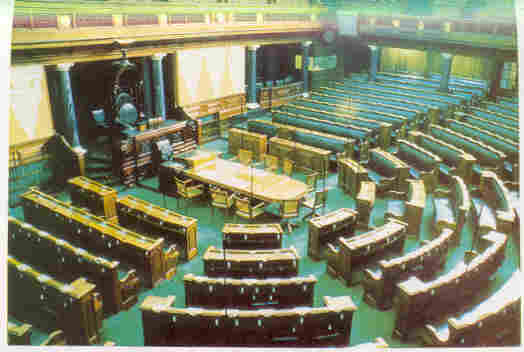
If the Parliament is the supreme symbol of the model of democracy that we blindly copy-pasted nearly 60 years ago, then it is dead. And death has not come due to a sudden stroke or seizure; it has followed a long illness that has criminally been neglected and allowed to become fatal.

What happened during Question Hour yesterday indicates that the time to perform its last rites has come. It is too late to resuscitate it. Not that anyone is even thinking about it.

Two years ago, the then Lok Sabha Speaker Somnath Chatterjee saw death coming. After actively, but unknowingly perhaps, participating in the process of killing it for decades, he got illuminated only after he got a chance to see from his high chair on the other side what his fellow parliamentarian were actually doing. On that day, when he saw them, for the umpteenth time, rushing to the well of the house with aggressive intent, shouting like drunk men in a brawl do, he told them what struck him in the twilight of his career: they were working overtime to finish democracy.

Were his words ever going to have any effect so late in the day, when the benign tumor had already turned malignant and had rapidly spread into all vital organs of the body of India's democracy? That is why, a year later, even more agitated by their uncouth, uncivilised and unacceptable behaviour, he lost control, to tell them something they always knew: they were insulting the people and wasting public money. But the crowning shame was that it was he who had to back off and apologise to them for speaking the bitter truth; not one of them felt that an apology to the people of India was due. They had gone way beyond shame.

Yesterday, any doubts that anyone might have had about the total irrelevance of the Parliament were set to rest.

A mandatory hour, known as Question Hour, is that period of time in Parliament when an MP can question any minister about anything related to his ministry. Needless to add, this is the time when those chosen by the people get an opportunity to raise issues of concern to the people of their constituencies directly at the highest level, to get answers thereof quickly and provide authentic information to them. This is that vital feedback loop without which proceedings of Parliament have little meaning for the so-called aam admi about whom every politician keeps shouting to stay in business.

But yesterday, this hour became a joke and collapsed. As many as 34 MPs who had submitted questions were found missing when Lok Sabha Speaker Meira Kumar called their names. This unprecedented apathy on part of these representatives of the people was the proof that Parliament was, for all practical purposes, a dead people's forum . A few years ago, the nation was shocked when a sting operation revealed that MPs were taking money to raise questions in Parliament. That expose possibly put brakes on that disgraceful practice. But it also took 'life' out of the Question Hour and exposed the total rot for what it is.

India's Parliament is now no more than an joint election platform that all political parties are using shamelessly to run their opponents down, as they do outside and in TV studios, during election campaigns. Meaningful discussion and debate on the many issues that this nation needs to address in a bipartisan manner have simply stopped taking place.

Those who have any doubts about how speedily things have deteriorated and reached this terminal point may like to look at the following statistics:
  • In the 11th Lok Sabha (1996 to 1998) 5.28 % of the total time was lost in pandemonium.
  • The above figure increased to 10.66% in the 12th Lok Sabha.
  • The figure more than doubled to 22.4 % between 1999 and 2004.
  • The 14th Lok Sabha recorded 38 per cent time lost in the first two sessions
  • The Rajya Sabha lost a whopping 46% time in the corresponding 201st and 202nd sessions
The basic reason for this precipitous slide is the completely flawed model of democracy that compels politicians to ruthlessly and quite horrifyingly cut the electorate into smaller and smaller pieces, along more and more dimensions. This, in turn, facilitates the birth and sustenance of dynasties at all levels due to which protection and promotion of family interests begins to take precedence over all else. This, let it be understood by all who think India, is what is weakening and hollowing the nation from within. When you add to this the fact that elections are now being held almost non-stop, politicians are left with little choice but to remain in a campaign mode inside Parliament all the time. Winning the coming elections by making disgraceful noises in Parliament and then in TV studios is what consumes them. No longer does one has any time for, or interest in, helping the government of the day run the nation by giving constructive criticism and feedback, or, as yesterday's shocker shows, in doing what he/she is expected to do by the people who have elected them.

India's democracy is now only 'by the people'. With the aam admi having been priced out of the election game which is now dominated by dynasties and criminals, it has ceased to be 'of the people'. And, as the death of the Parliament makes it clear, it is also no longer 'for the people'.

It is no accident that it is Dr Manmohan Singh, an honest 'non-political' politician with no family interests to promote, who has spoken about the failure of this model of democracy and expressed his apprehension about its survival.

I distinctly recall what Rahul Gandhi said last year when asked about the disgraceful manner in which parliamentarians shout each other down, and do worse, in Parliament. The young Gandhi said that he was proud that all MPs were able to freely express 'their' views in the House. Need more be said?