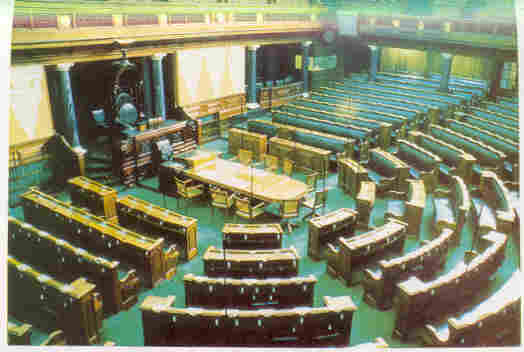
Showing posts with label indian democracy. Show all posts

Tuesday, February 28, 2012

POLITICIANS AND PEOPLE'S TEMPLE

Politicians fume when shown the mirror,
But will not fumigate Parliament ever;
We are supreme! they scream in horror,
Even thieves, rapists and criminals clever.

Unelected tyrants! challenge us not,
We are the voice of the indigent lot;
Ask not why the PM hasn't fought,
Or even the opposition’s main mascot!

Parliament, recall, is the people’s temple,
Their will outsiders have no right to tamper;
We high priests can loot and trample,
You keep voting us, so shut up and scamper.

Join us, they taunt, if you want to see change,
Coming from them it does sound strange.
Their game is of power and  the play is of gain;
The Church has appropriated God again.
'

Tuesday, August 23, 2011

INDIAN DEMOCRACY: CHANGE IS HERE

Well before Change arrives, discrete signs of the impending tumult start appearing, with increasing frequency and magnitude. Unfortunately, it is often in hindsight that seemingly stray straws are seen for what they really are: pearls on one string.

In 1947, we inherited -- and have persisted with -- 19th century colonial laws, administration, judiciary, police and other institutions of governance. In 1950, we gave ourselves a constitution that promised democracy to the people, but through a copy-pasted model that was developed over centuries by and for a tiny, almost-unitary, and culturally very different society for itself.

In sum, for creating an India of tomorrow, we placed our trust in instruments of yesterday.

The constitution has held till now, as have the electoral process and other institutions of state. And this achievement, more than anything else, is being used by those who have most benefitted from it to resist sorely needed changes which will, and must, pull them down from the colonial perches they seamlessly slid into after Independence.

Ironically, the Change that is threatening them was actually unleashed by them to shape public opinion and discourse to suit their requirements.

The completely unexpected and unprecedented support that Anna Hazare’s fight against corruption has generated contains some extremely important lessons, some of which I had discussed in the previous post. Perhaps the most fundamental message that the hundreds of thousands of young men and women out on the streets today are conveying is that they are no longer ready to wait indefinitely for politicians to deliver on issues that affect them directly, and are ready to force Change, if required.

Supremacy of Parliament and sanctity of the electoral process are the two arguments that opponents of Change offer to deride this upsurge, if not uprising. MPs are elected by the people to frame laws, win elections if you have a problem with what they are doing: this is their standard line.

Unfortunately for them, this is not 1947 or 1950, when a long oppressed, diffident people, led by outstanding, unelected leaders, were elated with the first flushes of freedom. The world has changed beyond imagination in the last six decades, and two generations later, the youth are not timorous like their grand parents -- they have as direct a memory of colonial rule as they have of other periods long past – and they see leaders of today as plunderers disinterested in, and disconnected from, them.

But above all, the most profound change that is driving the Change we are beginning to experience is the information revolution. 850 million mobile phones and a rapidly growing access to the internet have ushered in a social media revolution whose impact and power is re-writing the rules of democracy itself.

There were huge expectations when visual media was freed of government control. People were fed up of tightly controlled government manipulation of news and discussions, and were excited by the prospect of getting ‘real’ news from a free media. Daily voting on questions picked and debated by various news channels empowered them for the first time beyond the ballot box, and gave them a sense of participation like they had never experienced. Every day they got a real idea of the views of a significant section the population on live issues.

Politicians quickly realised that they could use free media by a mix of inducements and threats to shape and distort public opinion enough to alter voting choices of a critical numbers, to change defeat into victory. The people would never get to know, they reckoned, that it was almost DD all over again, without the give-away logo.

Tehelka's sting operation of 2001 and the Pink Chaddi drama of 2009 were two politically motivated campaigns that successfully achieved their objectives of damaging the BJP, and underlined the enormous power of the visual media in influencing, even determining, electoral outcomes.

Media business in India has been slave to the government of the day, and is now even more so, because the stakes are higher than ever before, making paid news and worse extremely lucrative. Media is, therefore, as status quo loving as politicians. The Anna phenomenon would have been successfully discredited and buried by it had a new 'media moghul’ not burst upon the scene from nowhere and fundamentally altered the rules of the information and opinion-making game.

Almost a crore and a half missed calls to Anna’s anti-corruption team, crores of sms messages exchanged about Anna and his anti-corruption campaign, and a free, informed, unbiased debate by well-informed netizens -- 21st century, often-ahead-of-the-curve reporters and opinion makers whom people trust – are the prime drivers of the revolution that we are seeing at Ramlila Maidan and all over the country.

The media – honorable exceptions apart – is being compelled to cover Anna; for the first time, it is following, not leading a campaign. Even more importantly, for the first time, people are not being influenced by the propaganda regularly unleashed by ‘experts’ and shallow, opinionated anchors who have held sway till now: the fast-growing web of social media is their new voice, one that will only grow louder. In fact so stung are some media stars by the almost brutal manner in which they have been sidelined, and their ‘Radia’ agenda lit up, that they have refused to cover this unfolding of history from Ground Zero right outside their doorstep.

What we are seeing on the streets is, at one level, the largest ever ‘opinion poll’ or survey ever conducted in India on an issue. Till now, the media was setting the agenda, quoting votes, blogs, tweets etc. of a few thousand – sometimes ever creating false handles to fake results/trends – to tell a believing India as to what its 'real' opinion was on various socio-political issues. Aided by unprecedented connectivity, Anna and his team have snatched that initiative from the middlemen-messengers by reaching people direct with their message.

Elections are a lot less about issues than they are about arithmetic. That is why politicians have become so arrogant and dismissive of the people. They have gamed this deeply flawed process to near-perfection by dividing themselves and voters along every usable fault line. This has effectively removed people from the process of governance and turned them into subjects who, even if they vent their anger after five years, can do little more than choose from among the small pool of the ruling elite that has realised that it can keep doing what it wants to, till election time, and that an election loss is temporary; no matter what they do, their opponents will do no better, and a helpless minority of voters will swing back and give them one more chance.

It is this effective disenfranchisement of the people that emboldened the government to do what it did to Anna Hazare in April, to Baba Ramdev in June and again to Anna now. It is this dis-empowerment that people are revolting against. It is this Change that politicians are either unable to grasp or unwilling to submit to.

The age of real-time connectivity and dissemination of information is here. And it is not one-way. A citizen with a mobile phone or an internet connection is no longer a passive, isolated recipient of news; he is also a creator and disseminator of it. He is an independent, one-man media house. He is not going to wait for five years to express his opinion through a vote that, for 65 years, has not addressed issues that touch him. He is not going to accept the argument that a ‘supreme’ Parliament is the private property of a few hundred individuals between elections.

These are ideas and instruments that were developed in, and were suited to, the age of pigeon carriers, horse-driven carriages and ships powered by oars and wind, by societies tentatively breaking free of the clutches of absolute monarchy. In 21st century, politicians cannot hide behind them and deny to people the power that should be theirs in a democracy. People have a right to demand day-to-day accountability from the people they have chosen to govern their nation. Thanks to technology, they now can.

Anna's movement may be crushed again by politicians. But what is of real significance is that, for the first time, people have come together, and experienced and expressed their power, without latching onto a political leader or party. They will come back again and again, stronger, better organised. If politicians do not learn, at some point they will turn violent too, with unpredictable results.

The days of treating a distorted democracy like a fixed-term dictatorship are over. Change is here. The sooner our politicians get a fix on this, the better.
'

Friday, April 15, 2011

ANNA HAZARE, LISTEN TO THE RAGE

Anna Hazare. Who had heard of this soldier before the Great Jantar Mantar Tantar rattled an arrogant government that thought it had everything under firm control, right from the media to the BJP?

I have not read the Jan Lokpal Bill that started the churn, the first stirring of a long delayed revolution. Nor do I intend to waste my time going through it. Many analysts on both sides of the divide have written copiously about it, and will continue to do so. Like millions of other Indians I do not want to get lost in a debate that misses, or deliberately deflects from, the real point.

Our collective rage is against a democracy that is being destroyed, a government – I use the term for state as well as central governments -- that has abdicated its responsibility to govern, and politicians who have become plunderers of their own nation.

Till Anna Hazare began his fast to death against the mischievous efforts of the political class as a whole to keep itself and the babus whose guidance and collaboration makes plunder possible, literally beyond the reach of law, the enormous energy of this seething rage was getting dissipated due to lack of point or leader of focus. The present government in Delhi was, not surprisingly, smug and disdainfully dismissive of all talk of reigning in unbridled corruption that has now reached levels that cannot be sustained without a serious blowout that might even lead to the demise of the First republic.

Anna Hazare gave the explosive charge of public anger the shape it needed. The resultant Munroe effect blasted a hole through the impenetrable armour of a devious government that, till the explosive shocked and burned it, was ridiculing and mocking the diminutive Gandhian and those supporting him. This hole in the hull is not symbolic, nor can anyone plug it with a rag and drive the tank back into battle. The Lok Pal Bill represents only the first exchange of fire between the people and a government that claims to represent them but has effectively ceased to. For 43 years, people may have kept quiet. No longer. No matter how hard politicians and babus may try now, an appropriate law will be put in place sooner or later, with or without them. But that will be only the beginning, not the end.

Expectedly, government forces are hitting back with all the heavy weapons at their disposal. Their target, no surprise, is the Teflon-protected complete outsider Anna Hazare. This non-English speaking, soft-spoken leader has, to the amazement of all, connected not only to the masses but also to young, educated urban Indians who, till he appeared on the scene, were being channeled to draw bubble gum ‘inspiration’ from cricketers, Bollywood stars and Rahul Gandhi. There was no real leader who had it in him to draw their attention back to where it should have been and galvanise them into action in the manner that Anna has done.

What has disturbed government troops the most is the fact that behind the members of civil society who are drafting the Lok Pal Bill are leaders and people they had all but rendered invisible and irrelevant. Baba Ramdev, Sri Sri Ravishankar and the like bring with them numbers that can drastically change the equations of elections that have been solved by politicians who have figured out that democracy is not about getting the people’s mandate, but about getting to power without it. With Anna Hazare praising Narendra Modi, arguably the only incorruptible political leader who is also a doer and deliverer without peer, and the latter too putting his weight behind the voice of the people, the balance of power has shifted quite substantially in favour of the people. When leaders of other religions too join Anna, as they should, it will become a no-contest.

Suddenly, the “idea of India” that uproots India from India, that does not recognise a timeless India as anything more a creation of the British, that disparages and mocks at everything Hindu, is in danger of being thrown into the only place it should always have been: the dustbin. The cocooned English-speaking elite and the secular brigade which is infested with parasites, thought -- just like the politicians did -- that they had it all covered with the help of a few missionaries, mullahs and media. Patriotic scenes reminiscent of the freedom struggle, starting from Bharat Mata on Anna Hazare’s stage, to the enthusiastic singing of Vande Matram, the national song they thought they had all but buried, has given them a rude reality check and woken them to a vast India beyond and very different from the soulless caricature they have reduced it to under the guise of ‘secularism.’

Anna Hazare is under attack not only from sarkari soldiers but also from deserters who did not get their free deserts from the government. The pressure being generated on him and other leaders like him to conform to their idea of India, one that has been built solely around the political objective of keeping Congress in power, is immense. They manifestly want to reduce him to a nominal head, a Manmohan Singh if you like, so that the corroded and hollowed edifice that they have all helped build and sustain remains intact. It is not going to be easy for him and those truly interested in rebuilding India to take the pressure.

No matter what people might say, I believe that a soldier who took a Pakistani bullet in 1965, will not run away from this battle, the greatest one that he has fought in his life. He will take all the bullets that are being fired at him now, achieve victory and pass the command to someone worthy of it.

But what Anna may not be able to take is the pressure from fifth columnists in his camp. They have no followers, no following, no rage. They need him and other leaders in the movement who have energised the masses, not the other way round. He must not let them set the agenda, the shape and the pace of the movement.They will only kill it. They are agents of status quo, not change.

Anna Hazare must listen to the rage of the people and remember the faith they have reposed in him. If he does and continues to give shape to it, he will remembered as the icon of the change that India desperately needed; if he doesn’t, he will be replaced and forgotten.
'

Sunday, September 5, 2010

NATHA NEEDS DENG, NOT DEMOCRACY

A few months back, the entire opposition had united to bring India to a grinding halt for a day ostensibly to protest against the back-breaking price rise that is hitting everyone except the rich hard. To me, the sight of well-fed, rosy-cheeked and inflation-proof politicians courting mock arrest on behalf of the poor was revolting. It was painfully palpable that they had neither any interest in nor concern for the poor in their hearts; they just wanted to show their strength by getting their cadres out on the streets and allowing them to vent their anger by vandalising state property. Not surprisingly, in the evening there was much chest thumping in TV studios about the success of a bandh that boosted their bruised egos but forced millions of daily wage earners and their kids to go hungry.

To add insult to injury, even though the situation remained unchanged for the aam admi, MPs of all parties gave themselves an over 300% hike in salaries shortly thereafter. If this insensitivity that is beginning to become alarming was not bad enough, some political leaders, already allegedly fattened by enough pelf to last them a few lifetimes, staged a mock parliament and bulldozed their way unashamedly to get the hike.

Did anyone remember that poor man then? Did any political party refuse the hike till inflation came down? Did the political parties giving lip sympathy to the decades-old demand -- approved by the courts -- of ex-servicemen for one-rank-one-pension remember them and put pressure on the government to first meet their just demands? Not at all. The same MPs who sleep forever when it involves issues that don’t affect them personally pushed through their bill in a matter of days.

The above incidents are only illustrative; there are as many available as you want. I know there are many who will find justification for both, the first one as a vital symbol of democracy and the second as the right of MPs to be paid well. The point is not about the right to protest or to a fair remuneration. It is about the broken connect between the people and their elected representatives, a sacred and vital bond that is the soul of democracy, without which it is no more than a sham that is sending out invitations to be swept aside.

Democracy means everything to the elite because it fulfills all their needs and greed, and allows them to secede without guilt from the India that is still struggling to get two full meals a day. Politicians love it because it allows them to proudly rule as feudal lords and plunder India without even the slightest fear of being punished. The bureaucracy, police, judiciary and the media are enjoying the rocking party too. Which other system will give such 'freedom'?

No wonder then that Mani Shankar Aiyar, echoing the voice of politicians and the urban elite cocooned in luxury, says he would rather be a poor man in democratic India than a rich man in an autocratic China. A couple of years back Barkha Dutt, on return from a visit to China that left her dazzled, had similarly dismissed what China has done for its aam admi by saying "we have democracy." Yes, she has it, Aiyar has it, as do I and probably all of us who are reading this article.

Aiyar can say that he would prefer living as a poor man in India because he knows he never will have to. By inserting 'democracy' into his argument he has also absolved his ilk of all blame for the mess that they have made of it till now as well as responsibility to fix it in future.

Does democracy ignite even a tiny a spark in Natha or the 800 million Indians living on less than Rs 50 a day? Given a choice, will he prefer to live in the India he does or in China? Natha is the face of India that none of us wants to see, that none of us wants the world to see, that many of us do not know about, that most who know about want to pretend it does not exist, that those who have managed to escape are thankful that they have and want to forget that it still exists for many.

To know who Natha is and how irretrievable rotten every instrument of the state has become and how disconnected our media is from more 70% of India, do go and see 'Peepli Live'. This Bollywood film is a rare masterpiece produced by Aamir Khan and brilliantly directed by first-time director Anusha Rizvi.

If you have no idea what it means to be poor in rural India, and if you are not a politician or a reporter, this film will jolt you and leave you deeply disturbed. As real as any film anywhere in the world can get, it shows you the real face of an India without hope, an India that virtually does not exist for those who rule it or 'cover' it, an India for whom democracy has no meaning, an India that is as wretched and cursed it was under British rule. Peepli Live also tells you why this India is going to remain without hope even as we celebrate India's great growth story and the astronomical salaries that some of us earn in another India that lives in an entirely different country.

In 1943, Abraham Maslow proposed a theory that human beings are motivated by unsatisfied needs and that lower needs have to be satisfied before higher needs can be addressed. This hierarchy of needs, often portrayed in the shape of a pyramid, start from basic physiological needs -- air, water, food, sleep -- followed by safety, social, esteem and self-actualisation needs. According to Maslow, one will be motivated to strive for higher needs only once the lower needs are satisfied. Bluntly put, if one does not have food to eat, he will be not be concerned about social esteem, freedom and lofty philosophical pursuits.

800 million Indians are still struggling to satisfy their physiological and basic safety needs. In fact millions of Nathas out there not only continue to suffer, the insensitive, manipulative and totally corrupt system that they confront is making it so difficult for some of them that the only sliver of hope they have of getting something out of it is by committing suicide; even then, as the film shows, the red tape can kill that too. What meaning can higher needs have for this ocean of humanity? Does the the model of governance matter at all? Democracy, autocracy, colonial rule, communism, monarchy -- all are still meaningless words for almost a billion people. All they are concerned with is delivery. In that the system has failed them completely, and there is no sign that it is going to change on its own.

Communism became a rage in the last century primarily because it promised and quickly met the physiological, safety and social needs of people. It failed because it did not recognise that the higher esteem and self-actualising needs that got activated as a result had to be met too. China saw the fatal weakness and dumped it for its own unique model that could respond to and meet higher needs as they emerged. The result is there for all to see. In 25 short years, its GDP that was then equal to India, has grown to five times as much. But what is of great significance is that China has not only pulled out all its Nathas from the claws of poverty but has also systematically created economic, social and governance conditions that is not choking rising aspirations.

This is not the India that our forefathers fought to free from British yoke. The founding fathers of the Republic erred, at the very least, in choosing a model of democracy that was developed over centuries by and for a tiny near-single race island nation whose people had long satisfied all their basic needs. Democracy filled their higher needs. For Natha it was mainly a question of survival in 1947 and remains so now. For him democracy has turned out to be a bondage, a curse. China made a similar mistake in 1949, though Mao's misdirected focus never veered from the poor. Fortunately, at a critical moment it was blessed with a Deng Xiaoping who all but threw Mao out of the nearest window.

Unfortunately, we are still stuck with petty pygmies who are working furiously to further distort the model by dividing people among dangerous fault lines and turning democracy into a plunder club of a few hundred dynasties. Their focus is on dimpled Rahul, not scraggy Natha. But the scion of the Nehru-Gandhi family cannot be the Deng that the nation deserves. Not that anyone who matters wants, expects or will let him or any known challenger be one. That can only be bad news for India.

The way things are, the big change agent that India desperately requires is unlikely to emerge from within the known political or bureaucratic establishment. When Deng pushed through the badly needed across-the-board reforms in China, he famously said that the colour of the cat is not important as long as it catches the mice. We need such a cat. For Natha.

Friday, June 25, 2010

35 YEARS ON, EMERGENCY MINDSET IS ALIVE

On June 25, 1975, the people of India had their first brush with dictatorship. Ironically, this 'coup' was executed by the very person who had sworn to protect democracy and the constitution. Indira Gandhi, the daughter of Jawaharlal Nehru, stunned by an Allahabad High Court verdict that found her guilty of violation of electoral laws, decided that she was bigger than the the law of the land. So, she staged a bloodless coup against the democratically elected Prime Minister that she was, and became India's first dictator.

Much credit has been given to her for holding elections in 1977 and then smoothly handing over power after she was voted out by the people. Perhaps some of it is deserved. But, it needs to be remembered that she went in for elections only after she was reportedly assured by the IB and others that she would win. However, when defeat shocked her, she was reluctant to hand over power to the Janata Party; that was her arrogance. She reportedly turned to Army Chief, Gen TN Raina, a fellow Kahmir Pandit, who she had chosen over the senior and much more distinguished Lt Gen PS Bhagat for the top job, and asked him to take over. Nehru's daughter asking the Army to take over India so that another politician did not! Couldn't be worse, could it? Fortunately for India, Raina refused. The rest, as everyone says, is history.

The Emergency was also India's first brush with the tyranny of the Nehru-Gandhi family. Indira Gandhi drafted her younger son, Sanjay Gandhi, who later died when the plane he was flying crashed into a tree, to help her run India with an iron fist and, boy, the duo took over the country and the Congress party completely. Their power was near absolute. Within the Congress, no one had the courage to utter a word against them; opposition leaders who did were put in jail; the media simply crawled.

As a result of the terror that the mother-son duo unleashed, and as often happens with despots, they were told by sycophants just what they wanted to hear. But in 1977, the people told them what they should have been hearing: how hateful their rule, their excesses had been, and how unacceptable. The tidal wave of public anger, particularly in North India where the Emergency really hit hard, was so huge that Indira Gandhi was defeated in her own constituency by a midget called Raj Narain.

Much has been written about what happened during the two dark years that the Emergency remained in force, and little purpose will be served by repeating it here. What is of real relevance now is whether the right lessons have been learnt and whether there is any danger of another politician placing himself/herself above everything else in the manner that Indira Gandhi did.

How much has really changed in the last 35 years? Is the Congress party more democratic now after that painful experience? Have its leaders developed a spine or are they still supine? Has the media, now free and more powerful than ever, learnt at at last to walk or has the gangrene that had set in then led to amputation of vitals? Have political opponents of the Congress learnt their lessons or has the experience of power corrupted them too and turned them into poor clones of the Congress, no longer real alternatives that can give a new direction and purpose to governance and to the nation?

The answers to the above questions are reasonably clear. In fact Family tyranny has got even stronger; don’t let the soft edges and the media spin fool you. Consider the following:
  • Then the Congress was run by Indira Gandhi her son Sanjay Gandhi; today it is by Sonia Gandhi and her son Rahul Gandhi.
  • Sonia Gandhi has already been Congress President longer than Nehru and Indira ever were. To make matters worse, there is not even a whisper of a demand either in the party or in the media to revive democracy in the party and give other leaders a chance to rise to the top. Sonia is now effectively Congress President for life. This is something unheard of in any political party in any democracy in the world. If this is the example that the GOP is setting, democracy is sure headed to death.
  • Sonia Gandhi may not be PM but she is far more powerful than the PM whose authority has been even further eroded -- manifestly to ward of any threat or challenge to her -- by a magical instrument known as the Group of Ministers (GOM) that is routinely tasked to take major decisions, shielding her from criticism but not credit, to ensure that only what she wants is done, but without being held accountable should anything go wrong.
  • Sonia Gandhi is the Supreme Commander of a government democratically elected by the people but she does not speak to them directly or even through the press. Natives of the party are left to do all the explaining and blame-taking. Even Indira Gandhi was never so arrogant and aloof.
  • No one in the Congress party can utter a word against any member of the Family, living or dead, out of fear. It is above and beyond criticism. Like God.
  • Surprisingly, almost no one in the opposition too criticises the Family. Manifestly that too is out of fear. The Congress has blatantly misused the CBI and other state instruments to tap phones and use other means to ferret out incriminating information about political leaders. That was apparently the sole achievement of the previous NSA. With corruption having reached unprecedented proportions and honest political leaders nearing extinction, most know that they are vulnerable. Blackmail, or the threat of it, is the new password that seals everyone's lips. Of course, everyone is allowed to hammer and make fun of Dr Manmohan Singh; that keeps everyone happy and undamaged. Even Nehru and Indira, tall leaders, were never so exalted.
  • The media crawls without having to be even told, eagerly. The rules of the game are clear, crossing of the Lakshman Rekha means swift and silent banishment to obscurity. Media is now big business with big money at stake. Makes eminent sense to keep the government on the right side and put the Family in the Pulpit. With corruption levels in the media now at par with those in the political class, vulnerability to blackmail and harassment is also as high. So, the Family has to be out of bounds for everything except reverence. No surprise that the anniversary of the Emergency has been blacked out. The new generation should not get ideas hostile to the Congress even in short attention span it has.
The the manner in which the furore over the duping of the victims of the Bhopal Gas disaster of 1984 has been handled by the government has dramatically underscored yet again the harsh truth that the Family is now totally beyond the pale of criticism. What started off as one $15 billion compensation suit in the US -- more to follow -- was turned into a paltry $475 million deal by the Rajiv Government with Union Carbide, Rs 30,000 for the dead and Rs 8000 for the injured. Billions would undoubtedly have been paid as bribe to top Congress leaders by Union Carbide for being let off the hook so unbelievably cheaply, over the dead and dying. But this scam, many times bigger than the Bofors one that brought Rajiv down in 1989, has been buried with exceptional haste. Rajiv Gandhi has been swiftly proved innocent of any wrongdoing in the gas disaster, not only by a pliant Group of Ministers who real job was to do that, but by almost the whole mainstream media, with leading journalists resorting to disgraceful tricks to successfully achieve this 'Mission Impossible'. The opposition too is silent; we know why.

The Emergency mindset is, thus, not only alive in the Congress, it is now even stronger than it was during the Emergency. The aam admi remains largely unaware because his testicles are not physically on the line now. But, there is enough evidence to suggest that he is no longer as relevant as he should be in a vibrant democracy. The Congress has sorted out the arithmetic of elections in a manner that has made him almost irrelevant, bar a sop here and there before elections to prevent a large swing. The opposition has also understood this game of numbers and has learnt to live with it, and make the best out of it wherever and whenever it can, even if means that some key leaders have to risk selling out to the Congress directly or via the CBI etc.

That is why there is zero possibility of any politician imposing the kind of Emergency that Indira Gandhi did again. But that is not because democracy has taken deep roots or is vibrant. That is primarily because there is no need for any politician to do with a hatchet what he/she can with a fake smile, except to set the occasional example. The corruption pie is now humongous, and there is enough for everyone to get something out of it. No one wants to spoil the party; keeping the mouth shut and treating the Family above all is a small price to pay. As long as the going is good. As of now, the highway ahead is paved with gold; there is no need or time to look on the side where the poor reside.
----------------------------------------------
May also like to read:
1. Politics and media: a new Nadir
2. Khaoists: Plundering India's future

Tuesday, June 22, 2010

SECULARISM: FROM 16 ANNAS TO 16 PERCENT

Secularism, the ideal, was adopted as the "official religion" of free India. The idea behind it was as simple as it was profound: every Indian, irrespective of personal faith, was an equal stakeholder of the new state. Unlike the breakaway Pakistan that chose to count only Muslims annas -- a rupee had 16 annas those days, not 100 paise -- as primary citizens with full rights in all walks of life, India chose the 16-anna model.

63 years down the road, in Pakistan not only have the 'khota' annas (non-Muslims and heretic Muslims) all but disappeared, the prized annas too are in danger. The new coins being minted do not have Jinnah's face on them. Laden, Hafiz Sayeed, Jihad and the like are already the new and only legal tender across vast swathes of that country, poised to either take it over or perish in spectacular flames.

In India, the anna has yielded to the paisa, both literally and metaphorically. Particularly in politics. No political party thinks or talks of 16 annas any longer except in vague generalities which mean absolutely nothing. When it comes to doing or getting something tangible -- and that to a politician means power and money -- the paisa takes over. Now 100 is a lot more than 16 and, therefore, much easier to "cut". And that is precisely what has happened. So, whether it is a business deal, a contract, a licence, or some such instrument created to enrich the politician (and the babu), percentages determine decisions and outcomes, rare exceptions apart.

Pecuniary corruption exists in every nation, though it is not quite so pervasive as in India and some other countries growing large banana plantations. While that is a disease that needs to be urgently attended to in India, the real, the one that should be ringing alarm bells, but is chiming instead, is political corruption that strikes at the very foundations of secularism.

Admittedly, our founding fathers were somewhat guilty of taking the SC/ST chavanni out of the 16 Annas. It is they who started what has become the mess of reservations, the abdication of responsibility of the rulers for their failures to deliver what they had promised when India became free. Of course, no one can accuse them of dividing society for petty political gains, and that too when they did it temporarily to right a historical injustice. They also can't be fully blamed if their less than worthy successors converted the chavanni into 25% on a permanent basis and then set in motion a dynamic that has already cut the original 16 Annas into percentages ranging from one to 27, the latter being the OBC cut that a certain VP Singh inflicted on an unsuspecting India purely for petty political gain. That did not materialise for him but it gave his fellow politicians many more percentages to divide the Indian rupee into and reduce India's secularism and democracy into the farce that it has become now except, ironically, for those who have seceded from it and organised their lives in comfortable cocoons.

These days, the hottest prize that politicians are salivating over is Bihar. To be more precise, the prize their gaze is fixed on is the 16% Muslim vote, a "bank" that they see as the difference between victory and defeat, between political wilderness and the untold riches that power promises and delivers. We are not talking only of regional parties with extremely limited interests and vision but extremely large expectations and ambitions. We are talking of national parties, including those whose historical appeal was the 16-anna one of the rupee before 1947 and what remained of it thereafter.

Much of the remaining 84% politicians have already cut up divided into small parts among themselves, giving the likes of Laloo Yadav, for example, disproportionate power and leverage, and the heady arrogance that they are above and beyond the law and the land. The 16% in focus now is not just defined by religion: it is most amenable to bulk voting based on religious dictat. Now this makes the division starkly communal by whichever definition you look at it. But, that does not daunt our politicians. They have managed to secularise even this exclusive piece by calling it "inclusive". No lessons have been learnt from the manner in which secularism has been hijacked by political parties and leaders who have gained power solely on the basis of votes of certain castes and communities, and who have blatantly corrupted all instruments that they can to unfairly 'reward' those of their castes/communities in return.

Now the game is to create even more, even smaller, pieces from the remaining general pie. That is the real reason for the demand for a caste census, reservation for Muslims and, at one level, women in Parliament. Let us face one simple truth: no piece can be termed to be "inclusive". The moment you lavish attention on one and give it an entitlement for anything, it has to be at the expense of another. Worse, the moment you appease one, you set in motion social dynamics that can have disastrous consequences even after and for decades. But who cares? The ones who should have protected themselves from its effects; they are not going to be personally impacted by any social or communal churning and violence except if and when it reaches the 'Bastille'. Since there is still no evidence of that happening -- the Indian cake being so hopelessly divided and weakened -- nothing is going to stop them from doing what they are.

The business of politics is now about grabbing and retaining power. All means fair. That is why secularism has slid from the 16-anna avatar it was conceived as to the 16% one we are seeing today and the 1.6% plutocracy that our politicians are in the process of turning it into, to ensure that India passes again into the hands of less than a thousand families and dynasties. Secularism is now little more than a political condom.

Monday, December 21, 2009

AFTER THE NADIR, A RAY OF LIGHT

How many of us have noticed the stark difference in the reaction of the media and intelligentsia to two recent developments of great import, one of which we should be proud and the other that should shame us? It will not a surprise if the answer to this question is another question: which ones? Even after the answer is known don't be surprised if many believe that the good development is actually bad and the really bad one, good.

What has happened in Andhra Pradesh is something that should shame us all, no? The sordid drama that turned one people into foes overnight because of the manner in which the separation of Telangana was announced at midnight, should have had the media out screaming. Who does not know that the whole charade was the direct result of the manner in which YSR Reddy, according to reports, enriched himself and his family beyond all proportions in just five years, turned much of the rest of the political class into plunderers and royally ignored Telangana leader and ally CS Rao?

Not only were most media mega stars were afraid to even whisper this bitter and damning truth, the usual suspects also overnight started selling to India the idea that there is great merit is having smaller states on all kinds of specious and often blatantly dishonest grounds. All that just to make the unprecedented plunder of Andhra look good and keep the Congress High Command unsullied. No conscience, no honesty, no nation.

Had it not been for the unbelievably foolish Shekhar Gupta, the real ugly underbelly of India's rulers, plunderers as he proudly called them only to make the division of Andhra lucrative for those who will suffer huge financial losses, would not have been so starkly revealed. In the process, he also unwittingly destroyed the credibility of sections of the media and exposed its complicity in keeping a lid on something that should have rudely woken Indians up and made them realise that their nation was in very wrong hands indeed. Remember how Bangaru Laxman was hounded by Tehelka and the rest of the media for taking Rs 1 lakh? YSR Reddy reportedly plundered close to a mind-boggling Rs 1 lakh crore, but there is praise for his dynamism! Do you think that would have happened had YSR not been protected, promoted and 'blessed'?

Coming to the second development; what do you think would have been the response if it had been thought up by someone but announced in the name of Rahul Gandhi? Tearing headlines, fawning TV studio discussions and relentless, saturated coverage to project how this original thinking signified the real change of guard, the arrival of the youth and the new direction that India's stagnating and failing democracy sorely needed.

Unfortunately for those who breathe not for India but their own little nests and empires, the man who has thought of one step that has the potential to set right some unacceptably enervating ills of India's democracy, is someone who is hated to death by them. Why is he so utterly unacceptable? Gujarat 2002, they will say in chorus, forgetting conveniently what one foolish decision, with no deaths involved, has done to one people with no history of animosity, much less sub-terranean tensions born out of many past riots and killings. That is only a - and the only - convenient chink through which they want to make a fatal penetration and fell him. Why? He poses the gravest threat to the comfort of status quo and the rot of corruption and nepotism that has enabled them to amass riches, power and titles and rise to levels that Laurence Peter never could have imagined people like them would when he propounded his famous principle.

Narendra Modi has stunned everyone by making voting compulsory in municipal corporations, municipalities and panchayats in Gujarat. Along with it, he has also given the voter the much-needed power to cast a negative vote and reject all candidates. This move, believes Modi, with great justification, will bring "the voter rather than the political party centrestage"

One more crime has been committed by Modi. In India, no one else other than the 'Congress', it seems, has the right or ability to do something good for the people. Other politicians and parties, if they are opposed to the Congress that is, can do only evil either because they are communal or because they are with those who are communal. The media and the accompanying paraphernalia have a clear cut role: create a non-existent genius in Rahul Gandhi and a villain in anyone who can rock his boat.

After the elections in Maharashtra, all these guys were lamenting the apathy shown by voters, particularly of Mumbai, and bemoaning the fact that some of those who shout the loudest in TV studios had mentally seceded from India. In hindsight, does it not appear absolutely elementary that someone should have thought of doing something about increasing voter participation, to get people fully involved in the electoral process? Should not people have been worried about this failed model of democracy, even when the PM himself had sounded the warning bell?

But, no one had the time, much less the inclination. They were, as always, having a good time and doing little more than waiting for their solitary fountain of wisdom to say or do something that they could applaud, add to most imaginatively and propagate in terrific prose. Keeping Indians believing in tomorrow even as institution after institution crumbles around them is no easy task!

Now that Modi has stunned them, once again, the reactions are predictable: Modi wants to exploit the superior organisational structure of the BJP to mobilise more voters; voting is a right not a duty; voting by dictat is dangerous; it is impractical to implement it across the country that has over 800 million voters; it takes away a fundamental right; it is an infringement of individual rights etc. No one, repeat no one, can honestly fault it as a partisan move that will benefit the BJP, or any other political party, at the expense of another. No one wants to mention the fact that 32 countries, including Italy, have already made voting compulsory. No one can question the intrinsic merit of the proposal but hardly any one with a reach is willing to risk his/her future and applaud it.

Why did only Modi think of it and give it shape too in such a short time? How did he, a Hindi/Gujarati-speaking guy from a humble background, once again manage to keep many feet ahead of the many Ivy League stars who adorn the Congress, and make them look like less than ordinary mortals, even midgets? As I have already written earlier, it is primarily because he is has no family to promote and is selflessly committed to Gujarat and India. He has a clear vision and is possessed by the belief that India can do much, much better than its leaders have allowed it to till now. And he has already demonstrated that it can be done even within the existing system that others have only exploited and then conveniently blamed, by tuning it to deliver. He is also scrupulously honest and leads a spartan life. But as Chief Minister, he is working with single-minded devotion to ensure that Gujaratis become rich and Gujarat becomes better than the best in the world.

Such men can do what has so far remained undo-able. Such men can awaken opiated masses who have not been allowed to shed their raja-praja mindsets that makes them accept plundering by 'royals' as their divine right and their own miserable fate as divine retribution. Such men are poison for those who have become plunderers, big and small, of their own land.

That is why, no matter how much India may need such men, the feudalistic elite who have taken over this country and the dynasties who have grotesquely twisted democracy to further their family businesses, will gang up against them to protect and further their own interests. That is why what should have shamed India is being covered up, justified and even obliquely praised. That is why what should have been welcomed as a positive, even if small, step to rid India's democracy and politics of the filth that has come to dominate it, is either being ignored or criticised.

But, there is hope yet. If Shekhar Gupta created a new Nadir by celebrating the plunder of India by its Indian rulers, Narendra Modi has re-kindled hope, fearless of the treacherous minefield in which he has been put. He has shown that there still are Indians out there whose hearts genuinely beat for the ordinary Indian waiting still for freedom to reach his doorstep; there still are Indians who have the strength, fire and moral courage to stand apart and away from those who have lost sight of their sacred duty to the suffering millions who have given them power with trust and hope. The spirit with which our forefathers fought to free us of yoke has not been snuffed out completely.

A ray of light is visible in the dark cave.
-------------------------------------------------------------------
Related reading:
1. Will Modi accomplish his 'Mission Impossible'?
2. Politics and media: a new Nadir
3. The Telangana domino: time to transcend parties, talk India
4. Covering up the mother of all corruption scandals
5. Wake Up...
'

Friday, December 18, 2009

WAKE UP...

Wake up sovereign, stop this plunder
Don't let them tear your land asunder

For netas elected in your name
Vote is free and nation fair game
Not for you, they're chopping it to loot
You will remain right under their boot

Wake up sovereign, stop this plunder
Don't let them tear your land asunder

Once they led inspired by ideals
Today they con driven by deals
Once from yoke they set you free
Today they pillage their own tree

Wake up sovereign, stop this plunder
Don't let them tear your land asunder

Brother from brother they separate
With false promises of a golden fate
Over morsels they make them fight
Such is their hunger for the big bite

Wake up sovereign, stop this plunder
Don't let them tear your land asunder

Nanak, your God is not their ship
Pirates they are on a power trip
Jihad, dharm-yudh, church and temple
Are weapons with which India they trample

Wake up Govind, stop this plunder
Don't let them tear your land asunder
--------------------------------------------------------------------
Shekhar Gupta's column in which he said, with some pride, that India's leaders were plunderers, shocked me. I did write an article based on the new low that India's politics has touched, supported by the media, but feel that there is a need to say much more. The matter is too grave to be just swept out of the mind only to avoid being perturbed.

This poem is the result of that disturbance, that agitation, in my mind.
--------------------------------------------------------------------
'

Tuesday, December 1, 2009

INDIA'S DEMOCRACY NOW ONLY 'BY THE PEOPLE'

If the Parliament is the supreme symbol of the model of democracy that we blindly copy-pasted nearly 60 years ago, then it is dead. And death has not come due to a sudden stroke or seizure; it has followed a long illness that has criminally been neglected and allowed to become fatal.

What happened during Question Hour yesterday indicates that the time to perform its last rites has come. It is too late to resuscitate it. Not that anyone is even thinking about it.

Two years ago, the then Lok Sabha Speaker Somnath Chatterjee saw death coming. After actively, but unknowingly perhaps, participating in the process of killing it for decades, he got illuminated only after he got a chance to see from his high chair on the other side what his fellow parliamentarian were actually doing. On that day, when he saw them, for the umpteenth time, rushing to the well of the house with aggressive intent, shouting like drunk men in a brawl do, he told them what struck him in the twilight of his career: they were working overtime to finish democracy.

Were his words ever going to have any effect so late in the day, when the benign tumor had already turned malignant and had rapidly spread into all vital organs of the body of India's democracy? That is why, a year later, even more agitated by their uncouth, uncivilised and unacceptable behaviour, he lost control, to tell them something they always knew: they were insulting the people and wasting public money. But the crowning shame was that it was he who had to back off and apologise to them for speaking the bitter truth; not one of them felt that an apology to the people of India was due. They had gone way beyond shame.

Yesterday, any doubts that anyone might have had about the total irrelevance of the Parliament were set to rest.

A mandatory hour, known as Question Hour, is that period of time in Parliament when an MP can question any minister about anything related to his ministry. Needless to add, this is the time when those chosen by the people get an opportunity to raise issues of concern to the people of their constituencies directly at the highest level, to get answers thereof quickly and provide authentic information to them. This is that vital feedback loop without which proceedings of Parliament have little meaning for the so-called aam admi about whom every politician keeps shouting to stay in business.

But yesterday, this hour became a joke and collapsed. As many as 34 MPs who had submitted questions were found missing when Lok Sabha Speaker Meira Kumar called their names. This unprecedented apathy on part of these representatives of the people was the proof that Parliament was, for all practical purposes, a dead people's forum . A few years ago, the nation was shocked when a sting operation revealed that MPs were taking money to raise questions in Parliament. That expose possibly put brakes on that disgraceful practice. But it also took 'life' out of the Question Hour and exposed the total rot for what it is.

India's Parliament is now no more than an joint election platform that all political parties are using shamelessly to run their opponents down, as they do outside and in TV studios, during election campaigns. Meaningful discussion and debate on the many issues that this nation needs to address in a bipartisan manner have simply stopped taking place.

Those who have any doubts about how speedily things have deteriorated and reached this terminal point may like to look at the following statistics:
  • In the 11th Lok Sabha (1996 to 1998) 5.28 % of the total time was lost in pandemonium.
  • The above figure increased to 10.66% in the 12th Lok Sabha.
  • The figure more than doubled to 22.4 % between 1999 and 2004.
  • The 14th Lok Sabha recorded 38 per cent time lost in the first two sessions
  • The Rajya Sabha lost a whopping 46% time in the corresponding 201st and 202nd sessions
The basic reason for this precipitous slide is the completely flawed model of democracy that compels politicians to ruthlessly and quite horrifyingly cut the electorate into smaller and smaller pieces, along more and more dimensions. This, in turn, facilitates the birth and sustenance of dynasties at all levels due to which protection and promotion of family interests begins to take precedence over all else. This, let it be understood by all who think India, is what is weakening and hollowing the nation from within. When you add to this the fact that elections are now being held almost non-stop, politicians are left with little choice but to remain in a campaign mode inside Parliament all the time. Winning the coming elections by making disgraceful noises in Parliament and then in TV studios is what consumes them. No longer does one has any time for, or interest in, helping the government of the day run the nation by giving constructive criticism and feedback, or, as yesterday's shocker shows, in doing what he/she is expected to do by the people who have elected them.

India's democracy is now only 'by the people'. With the aam admi having been priced out of the election game which is now dominated by dynasties and criminals, it has ceased to be 'of the people'. And, as the death of the Parliament makes it clear, it is also no longer 'for the people'.

It is no accident that it is Dr Manmohan Singh, an honest 'non-political' politician with no family interests to promote, who has spoken about the failure of this model of democracy and expressed his apprehension about its survival.

I distinctly recall what Rahul Gandhi said last year when asked about the disgraceful manner in which parliamentarians shout each other down, and do worse, in Parliament. The young Gandhi said that he was proud that all MPs were able to freely express 'their' views in the House. Need more be said?

Tuesday, November 24, 2009

CAN INDIA REMAIN A FUCTIONING DEMOCRACY?

India's democracy is ill. This is a reality that no one can deny. But just how serious is this illness? Is it curable or is it only question of time?

Dr Manmohan Singh, an economist who became a politician by accident, is not known to make loose statements, much less dramatic ones. So, when he says something his inimitable manner, attention needs to be paid to it. Speaking to Fareed Zakaria of CNN a few days back, Dr Manmohan Singh's response to a single question about a lesson that a democratic India has to teach the world, has perhaps not got the attention it should have. In his brief answer, he qualified his answer by saying as many as three times, "if we do succeed" in remaining a functioning democracy.

Seen in isolation, one can be accused of reading too much in too little. But this is not the first time the Prime Minister, a man of spotless personal integrity, has voice his concern about the shape our experiment with democracy has taken. Two years back, he had spoken openly about the ills of the model of multi-party democracy that India has adopted, the model that has almost castrated the nation and rendered effective governance virtually impossible.

Shedding his characteristic soft stance, he had then candidly questioned whether "a multi-party model where parties with varying national reach and many with a limited sub-national reach is capable of providing the unity of purpose that nation states often have to demonstrate." The problem, he elucidated, is that “Sometimes the resolution of problems acquires an excessively political hue, and narrow political considerations, based on regional or sectional loyalties and ideologies can distort the national vision and sense of collective purpose”.

That was not all. Dr Manmohan Singh actually went to extent of favouring a single party system. "A single party state has many advantages in managing Centre-state relations smoothly as opposed to a multi-party system, or is a multi-party model, with national parties dominating the political scene, superior, where one can hope that all of them will take a national view on policy issues and help to reinforce the unity of the federation?"

Two years later, Dr Manmohan Singh remains as skeptical of India's success as a functioning democracy as he was then, and as many right-thinking individuals have been for a long time.

That a damning criticism of our democracy and apprehension about its success have come from the Prime Minister himself, is a serious indictment of not only the political class as a whole, but also of the analysts and commentators hogging prime media space and singing praises of what is increasingly appearing to be a sham that has only widened the gulf between the rulers and the ruled. No one can place his hand on his heart and say that our model truly gives us a government of, by and for the people. While politicians may have forgotten the real purpose of democratic politics, thanks to the dynasties and the muck they have created, others have no justifiable reason to feign such amnesia and blindness. Unfortunately, many of them have been so corrupted by the very politicians they are supposed to keep a watch on, that the dividing line between the two has, ethically and practically, all but ceased to exist. The cancer of a fearless and shameless politician-bureaucrat-criminal-police-media nexus has spread deep into all institutions that define any state.

Parliament has become such a joke, nay, a national shame, that even former Lok Sabha Speaker Somnath Chatterjee had, on more than one occasion, to tell MPs that they were working overtime to finish democracy. Elections are now held at various levels almost nonstop around the year. As a direct result, proceedings of Parliament have started to look like more like 24/7 news channels, as all political parties expend their energies in scoring sensational political points over their opponents as part of preparations for the next elections. They have neither any time nor inclination to talk about governance and the many very serious issues facing the country, in a responsible, bipartisan manner. The focus remains on petty politics of the worst kind, no matter what.

Ironically, to the poor voter, the real 'sovereign' on whose behalf his so-called representatives shame the nation again and again, this democracy means little more than the freedom to cast a vote once in five years; sometimes even that small freedom of choice is usurped by his 'leaders'. For 850 million Indians still living a sub-human existence on Rs 20 a day, it has not had any meaning whatsoever for 63 long years.

The only thing that really energizes our politicians are gutter fights for the petty political power they are desperate to physically experience and enjoy as individuals and parties, just as spoils of war are in a foreign land. Morality is not even a factor any more as politicians of all parties willingly rip apart every single norm of civilized behavior in their unbridled greed and lust for perverse, personal political power. Hypocrisy, corruption and falsehoods have become so pervasive that they are not issues that disturb any longer or discussed any more except when politicians are throwing blame at each other or scoring pathetic political points in TV studios. Regional and sectional ideologies and aspirations are little more than convenient tools exploited without a care for the larger societal and national consequences, just for the sake of getting power in the next elections or to vent frustration at having lost the last one.

Our founding fathers had adopted the Parliamentary form of democracy of England, where this system suited for governing a tiny island had evolved over a number of centuries to suit its specific requirements. Many of India’s states are larger than that Atlantic island, and the diversities are enormous. Unfortunately, just freed from the yoke of colonial rule which influenced them deeply, our founding fathers failed to realise then that in this country comprising of many ‘Englands’, democracy would not develop into the comfortable two-party avatar that they had seen there.

With numerous regional, sectarian and ideological strains at work, governance has become incidental, an unpleasant chore that has per force to be performed as the byproduct of power, getting which is increasingly becoming unpredictable and slippery. Ironically, in this model of democracy, a party or a group does not even need to get the mandate of the country to come to power. Even when the nation or a state collectively finds none of them fit to rule, a hobbling arrangement can be cobbled up with quite disgraceful methods and compromises to run a virtually non-functional government, blackmailed at every breath.

Democracy is no more than a system of governance, a means to take a nation and its people forward. It is not an end in itself, as many romantically believe, to be placed above national interest, which they don’t understand. It can, and should be, discarded for a better system, if it does not remain responsive to the ever changing internal and external dynamics that a nation has to deal with.

The multi-dimensional failure of our multi-party democracy is something that should be of concern to not just our Prime Minister. Unfortunately, there is little evidence to suggest that others who are happily enjoying the fruits of its many failures and distortions are willing to make even small personal sacrifices for the common good of all. That is why with every passing day, we hear of more and more things going from bad to worse. Those who should be having sleepless nights about the direction in which things are going, are having sleepless nights alright, but partying.

That is perhaps why Dr Manmohan Singh is worried that India will not remain a functioning democracy for long, unless radical changes are ushered in, in time. He also knows that our leaders will not make even a small change that is crying to be made till they are pushed into a corner from where there is no way out. He was brought in to save India's almost sunk economy only after India had to pawn 47 tons of gold to stay afloat and had absolutely no idea about how to get out of the deep shit hole that its leaders and bureaucrats had put it into.

Then the failure was uni-dimensional and could be rectified by a brilliant economist. Now the failure is along nearly every dimension and goes well beyond just the fatally flawed model of democracy. An isolated fix here and there is not going to help anymore. Since there is no effort to attempt even that as of now, one wonders whether Dr Manmohan Singh, who has the best view in town, is actually seeing it failing in the foreseeable future. I certainly am.
'

Thursday, October 29, 2009

FOR BHARAT'S SAKE, AND INDIA'S, DUMP COLONIAL INSTITUTIONS

In the middle of all the noise in the media about the Naxal problem, brought to the fore again by the 'train-jacking' of the Delhi-Bhubaneswar Rajdhani by nearly 500 citizens, an extremely important aspect is being overlooked, yet again. But that is not surprising.

As far as media is concerned, everything has to be summarily reduced to politics after a perfunctory analysis because that is all that most media stars are drenched with, given their backgrounds and almost zero experience of, and exposure to, Bharat, a part of which is up in arms against India today. I still remember the shocking Nithari killing and cannibalisation case. A celebrated anchor, after a brief visit to the bowels of Noida, immediately turned the debate to the 'political dimension'. Why was that done? Because that is all what most Delhi journalists understand; the then CM of UP, Mulayam Yadav, and the Centre were daggers drawn - it made a great story. Also, most media stars we see have virtually no idea of how things work at the ground level on a day-to-day basis, or how the police, or any other instrument of state, is organised and the manner in which it functions.

That is mainly why serious systemic and institutional failures at the point of interface between the state and the citizen keep getting pushed under the carpet in every debate. That is what is happening now too.

In so far as politicians are concerned, the picture is no less dismal. At the state level, the whole thing has turned into a political blame-game between the Communists, who are in power in West Bengal, and Mamata Bannerjee who wants to evict them. At the level of the Centre, it has been turned into a black-and-white fight between the state and those who are questioning its failures through armed rebellion. As far as most human rights activists are concerned, it is almost exactly the opposite: the state is the terrorist; it is to blame for driving its own people to picking up arms to redress their long unheard grievances; therefore, it should abjure force and hold talks unconditionally.

The few senior cops who have been taking part in discussions across channels have, quite expectedly, been taking the official line that it is the duty of the state to act with force against those who have picked up the gun. Bureaucrats, particularly those who have served in Naxal affected areas - 150 districts - and have a first-hand experience of the sordid mess that their administration has been making over decades, are not to be seen or heard anywhere.

There is virtually no voice on the airwaves saying that there is something fundamentally flawed with our system of policing and administration that needs to be fixed. I have been saying for a long time that the antiquated, colonial system that India seamlessly continued to follow after the the British left needs to be overhauled completely. It is an elitist system that is primarily responsible for not letting British India become the Bharat that it should have after Independence. On the contrary, it has only increased that divide and created a whole new class of Indians who are completely disconnected from almost 80% of their country men who, for them, live in another country called Bharat.

The British created two institutions, represented today by the IAS and the IPS, with the sole purpose of using them as instruments of colonial power to ensure that the natives did not create any law and order problem against their imperial masters, and quietly paid taxes etc that the Empire wanted them to, to generate revenue for its own sustenance and growth. They were British institutions manned by English-speaking brown men for and on behalf of the Empire alone. Their organisational structure and functions were designed to prevent them from identifying themselves with natives or empowering them mentally or materially in a manner that would make them feel that they were equal to them, the Indian elite, much less the white man himself.

63 years after Independence, the structures and attitudes remain virtually the same, the exceptions being stray individuals. The DC and SP of a district continue to remain remote, imperial sahibs who reside in huge, barricaded bungalows looked after by a retinue of native servants. They continue to believe that they are the lords and masters of the many deprived souls with whom they share no affinity, and natural claimants to a 'cut' in the glamour and wealth of the few - criminals included - who need their protection and patronage to flourish without being troubled by the poor whom they sometimes exploit. So, most of them spend the little time they get in these appointments, where they are in direct contact with their own people, doing what India's colonial masters and rippers did to a conquered, alien people over a hundred years ago.

The connect that the most important powerful instruments of the state must have with its people as the equals that they are supposed to be in a democracy, thus, does not even begin. It is institutionally precluded. The same attitude and approach has filtered down to all other institutions and officials. That is why democracy and freedom have not yet touched millions of Indians, save during the occasional trudge to the voting booth. We are reminded of their existence only when they either pick up the gun to show their anger at their colonial administrators, or when they are misled by those like the Maoists who promise them that only the ones with guns share their heart beats and feel their pain, as equals, and will wrest their rights for them.

It is these very imperial administrators and police officers who, after a few years, go on to head various government departments and police forces. Since only they know exactly what is wrong within, but have been the direct beneficiaries and perpetrators of the increasing rot, they also know best how to con the rest into believing that since they are the best brains that India has thrown up after one exam, only they know what is for best for India, and are doing it, despite dirty politicians. They also know how to convince/pressure others that the only way to improve anything is by giving them even more power and control!

How completely these guys have corrupted the system can be gauged from just one example. When the Pay Commission recommendations were being finalised, former Cabinet Secretary TSR Balasubramanian actually said in a live television debate that bureaucrats like the Commerce Secretary, Finance Secretary etc deserved a Rs 10 crore salary, 1000 times the President's, for the kind of work they do. Can you see what he was trying to say? He was openly claiming a 'cut' for the the initials and recommendations that babus put on files, only because someone stands to benefit from those decisions financially!

This is the attitude at the very top of the heap, not at some lowly octroi post. It is this approach that has destroyed nearly every institution of the state. No official is ready to do something unless he is paid for it; and if he is well paid, he is willing to even to do what in his position he must not, no matter what happens to the people adversely affected by it, particularly if they are poor, second class natives who live in another world. When you add to this the impossibly complex rules that make it virtually impossible to hold government employees, from secretary to sweeper, accountable for almost anything, and assured promotions for doing little more than staying alive while in service, you get the sordid spectacle of sloth, absenteeism and near total absence of motivation to even think of excelling.

Subramanian has also said on a number of occasions, almost with pride, that corruption is no longer an issue and that nobody ever gets convicted for it; the rot is so deep and completely accepted. I may also mention here that, in a moment of weakness, a very senior official once told me that he was not in service for the salary; that was not sufficient to meet even the pocket money needs of his two teenage kids, he said. That says everything about what babudom has done to some of our best brains and what they have in turn done to destroy it.

Sitting in our urban bubbles, relatively untouched by the state, some of us may not find it easy to understand how colonial institutions of the state have alienated its citizens in the remote areas that we will perhaps never step into. Some celebrity activists do go there, but more often than not, they do so in pursuit of greater visibility and space in the national media, and in the West, rather than out of any genuine empathy or sense of belonging with these people. That is why they invariably come out with half-baked, uni-dimensional, even childish, responses that are often dishonest, because they primarily want to sensationalise and provoke rather than bring about the real change that is needed to help those whose cause they claim to champion.

India's top civil servants are not going to let the failed and almost completely dysfunctional colonial structure that benefits their small but very powerful tribe be disturbed at all. Unless they are forced to. Given our equally corrupt political system that has aggravated the problem by promoting rule by division rather than inclusion, one can be reasonably certain that meaningful change is not going to be ushered in willingly.

Yes, the armed rebellion of the Maoists needs to be crushed and the writ of the state established. But what we must realise is that unless the existing institutions of administration, policing etc are discarded and replaced by ones that firmly re-connect the state with its people as equals, rebellion in some form or the other will have to be faced time and again. Today it is in the hinterland; tomorrow it will be in your city. The form and method may be different but the rage and pain will be the same. And the intensity will keep on rising till India and Bharat become one.
-----------------------------------------------------------------------
Readers may also read:
1. Democracy - mockocracy - revolution
2. Capital punishment, not gain for the corrupt
3. 1000 times President's salary for India's babus!
4. Corrupt, colonial India faces volcano
5. Covering up the mother of all corruption scandals
6. Conspicuous consumption and conspicuous poverty
7. Bharat and India: armed rebellion and mental secession

Tuesday, October 20, 2009

INDIA HAS MUCH TO LEARN FROM CHINA, AND MUST

China's dramatic transformation into an economic power house in virtually the blink of a sleepy Indian eye has shaken some Indian leaders out of their misplaced slumber. It is beginning to dawn on them that India has to get out of the self-congratulatory mindset that it has got stuck in following a few years of relatively rapid economic growth on a small base, because that is not going to get it anywhere close to what China has achieved. But, as always, this reactive response is very limited, and is destined to fail.

It has taken Prime Minister Dr Manmohan Singh to ask the lethargic Planning Commission to wake up to what China has done to its railways and prepare a road map to reform Indian Railways. Two decades back, Chinese railways was behind its Indian counterpart. Today, it carries four times more freight and is expanding three times faster. Since 1992, the Chinese have added 1,000 km of tracks every year as against 100 km by the Indians. But it was India's Railway Minister Laloo Yadav who, at the behest of his bureaucrats no doubt, pompously made a fool of himself by showing off his 'management skills' to students of Harvard, Wharton, IIMs etc.

This is precisely the kind of political and bureaucratic deception that has kept India in darkness even while our biggest neighbour has flooded its almost 1.5 billion citizens with the light of progress and prosperity. The media has helped in this failure too. It has remained completely focused on the West, which is its reference point, and has continuously dismissed China, with which it is unfamiliar, in one line by saying that it has a totalitarian regime while India has democracy. 77% Indians who continue to live in darkness on Rs 20 a day must feel as blessed by democracy as the few who have millions to splurge.

We have gone horribly wrong somewhere. What makes this worse is that we could and should have done much better. This self-inflicted failure is best exemplified by the fact that the two areas in which India has excelled at a scorching pace are those where the shackles put by the government are the weakest. From a situation when there was a waiting period of 10 years to get a telephone from the government - and unaffordable long distance tariffs - to becoming the second largest mobile telephone market in the world with the lowest tariffs, in a little over a decade, is an astounding achievement. Same is the case with the software industry where India has been able to become a global player from nowhere, thanks to a few visionaries and the near-complete absence of bureaucratic interference.

There is little doubt that the whole process of governance and its framework needs to be overhauled. But, there is not even a thought in that direction. That is primarily because those who are benefitting the most by the existing system are the ones who have the power to decide on the changes to be put in place. And they know better than all of us that any real change will render them almost completely irrelevant. That is why no one looks towards China, and that is why everyone keeps going on learning tours to the West - where their kids live/study - only to come back and do nothing.

The Prime Minister must know that piecemeal directions like the one that he has given are not going to make the Indian Railways get ahead of, or even close to, the Chinese, ever. Their railways has not steamed ahead in isolation by accident. Nor has ours failed to get any real move on vital national projects like the two dedicated freight corridors, among many others, by chance or due to bad luck. Or because India is a democracy.

Something has to be done about the sloth and the lack of purpose and pride that afflicts every government department. Something has to be done to put a sense of time and urgency into decision-making and enforce accountability. Something has to be done to end the colonial disconnect between arms of the government and the people, and involve the latter more meaningfully in governance.

Even the Russians, recently 'blessed' by democracy, are not letting that model of governance blind them to the needs of their country. In 1949, the People's Republic of China was born with an ideology it had aped primarily from the erstwhile Soviet Union. Exactly 60 years later, the balance of economic and ideological power has reversed. But Russia is not sitting either on false pride or the idea of democracy. As per a report in The New York Times, it is openly looking at China as a role model. Russian Prime Minister Vladimir Putin is examining how his country can emulate China which has used a one-party system to not only keep the country well-governed but also drive unparalleled economic growth. The Russians are keen to learn lessons from the divergent paths taken by the two countries in the last couple of decades in which Russia has had to endure dark days while China has carried out a similar shift smoothly and powerfully. We should have been doing the same too.

Many living Chinese nationals have seen their country change three times almost completely. A feudal and backward nation of opium eaters became a communist state in 1949. That change turned the society on its head and lead to millions of deaths as Mao Zedong tried to put communism into practice at every level. That also resulted in a famine that saw around 35 million Chinese die. Such disasters made it evident that there was an unbridgeable and unacceptable gap between the theory and application of communism. Rapid economic growth required to catch up with West and usher all round prosperity was simply not possible with that ideology. That is why after Mao, Deng Xiaoping wisely dumped communism before if could throw the country into chaos again, and evolved a new brand of capitalism with a one-party rule. China also did not allow dynastic politics to take root, as was attempted by the Gang of Four led by Mao's widow.

In contrast, what have many living Indians seen? As far as governance is concerned, no one can tell when colonial rule ended and free India began; the only visible change that Independence ushered in was that the leaders elected by the people stopped reporting to the Governor General and the British Crown. Thanks to a couple of visits to the the Soviet Union that impressed him, Nehru tried to marry socialism with a colonial government structure, only to gave birth to the licence permit raj, unbridled corruption and many other ills that almost choked India to death. It was only after India had to pawn 47 tons of gold in the early nineties to stay afloat that some regulatory chains were loosened. That one step, forced by extreme circumstance mind you, is what saved India and allowed it to register faster economic growth. But when seen in the light of what China has achieved, our many failures easily swamp our few achievements.

Thus, if there is one nation from which India can learn the lessons it needs to about the whole business of governance and economic upliftment, it is China. The copied model that we have stuck to without daring to change some things laid down around 150 years back, has done nothing at all to give the taste of freedom and economic empowerment to nearly 80% of India's citizens even after 63 years. China, on the other hand, has continuously experimented heavily, from the individual upwards, to evolve a system that works like no other, and become a super power.

What is it in their system of governance, planning and implementation that allows the Chinese, for example, to pro-actively think of and then build the kind of railway system that they have, to construct a railway line into Tibet through permafrost conditions and heights of 16,000 feet? What are the structures of governance, revenue and expenditure in villages and towns that ensure that benefits of economic progress reach the last citizen and do not remain confined to the top 15-20%? What is their unique national security and strategy apparatus that is always ahead of the curve and on course to actualising the power and strength that is required to protect the economic and security interests of a nation of 1.5 billion people?

Answers to these and many other questions are urgently required by India. Piecemeal, reactive efforts to replicate what the Chinese have achieved are not going to take India where it should reach with its enormous and as yet unexploited strengths and capabilities. The Chinese have not reached where they have is so short a time by such reactive and disjointed efforts. Had they adopted that approach, they would surely have still been behind India in most fields, forget about going past America.

India and Bharat have to be united without further delay. And that, as should be evident to everyone by now, is not possible through the use of the very instruments of state that have created them in the first place. To this end, there is much that we can learn from China, more than we can from any other country.

A task force or commission needs to be set up without delay to study in detail every single instrument of governance, from the bottom to the top, in every single field, that China has evolved and put in place based on its experience and cultural genius. The task force should not include a single politician or bureaucrat or anyone vulnerable to them because that will make it a non-starter and ensure that only cosmetic changes that increase their power and authority are implemented. Only a completely honest and open-minded approach that has India, including Bharat, in focus will unshackle the genius of this nation and enable a vast majority of its people to experience the glow of freedom for the first time.
-------------------------------------------------------------
Readers may also read:
1. Conspicuous consumption and conspicuous poverty
2. Focused China powers ahead of shackled India
3. China and India: competition of civilisations
4. Bharat and India: armed rebellion and mental secession
'